There is a particular kind of knowing that only arrives slowly. Not the knowledge gleaned from a guidebook or a curated feed of photographs, but the quiet understanding that settles in when the world passes at the pace of a rolling wheel rather than a jet engine. The Romanian Carpathians have long been one of Europe's most quietly dramatic landscapes — layered with dense fir forests, Saxon villages, and peaks that dissolve into cloud — and there is no better way to absorb their character than by train, preferably on a route that takes its time.
The Geography That Rewards Patience
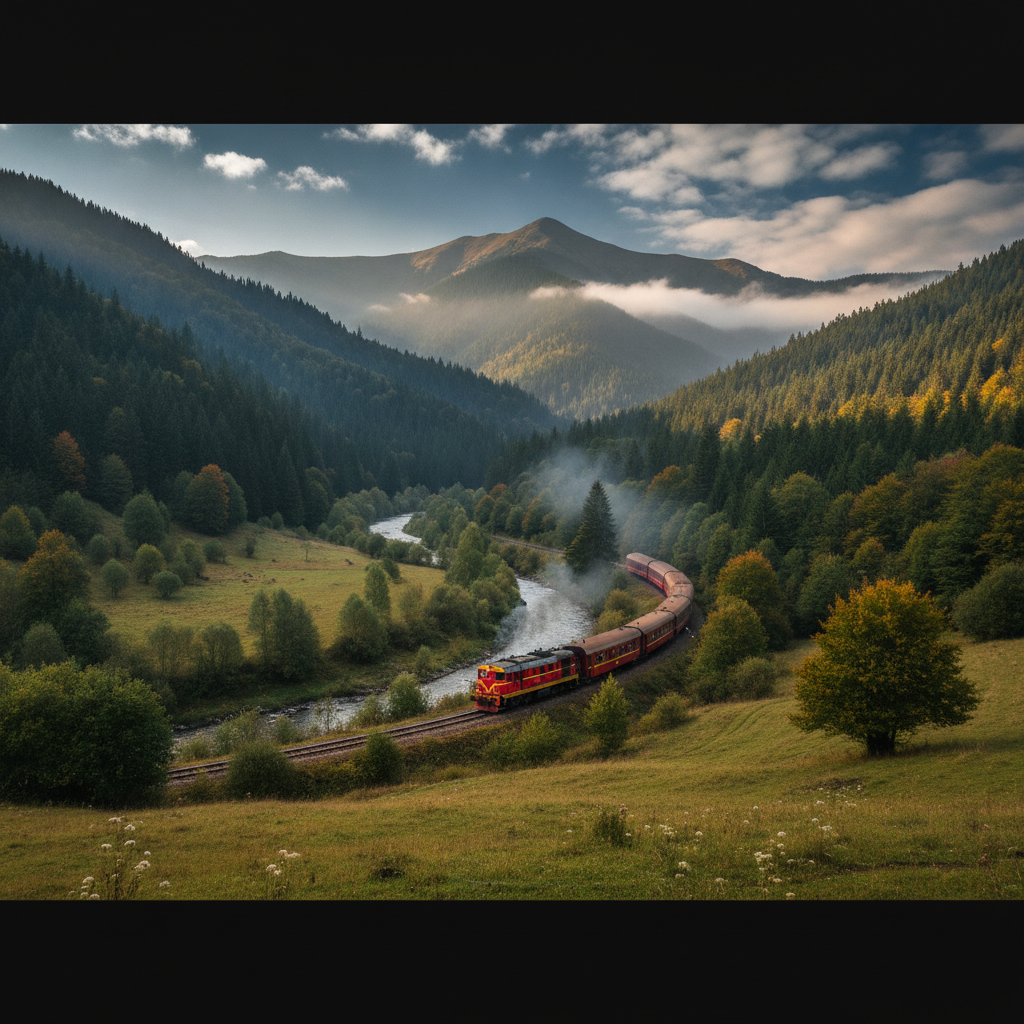
Romania's rail network threads through terrain that would humble most infrastructure projects. The CFR Călători — the national rail company — operates routes across the Carpathian arc that pass through valleys, mountain passes, and small towns that haven't changed their essential rhythm in generations. The Sinaia-to-Brașov corridor is perhaps the most celebrated stretch, but the trains running northwest toward Cluj-Napoca or southeast into the Prahova Valley offer scenery that is, if anything, even less mediated by tourist attention. On these routes, the elevation changes steadily, the light shifts from valley shadow to ridge-top brightness within minutes, and the window becomes something closer to a painting than a portal. Flights between the same points would cost less time but surrender all of this entirely.
The slow train — and Romanian trains are, by international standards, genuinely unhurried — creates a relationship with distance that air travel actively destroys. When a journey between Sinaia and Sibiu takes several hours rather than forty minutes, the traveler arrives not just at a destination but inside a context. The forests are no longer a green blur seen from altitude; they have texture, depth, and the particular silver-green of spruce needles catching afternoon light. This is not inefficiency. It's a different and arguably more complete form of travel.
What the Villages Along the Line Reveal
The train stations of rural Romania are a study in the country's layered history. Many were built during the Austro-Hungarian period, and their faded Habsburg-era facades — terra cotta walls, ornate ironwork, station names painted in serif fonts — speak to a cultural inheritance that the country absorbed and then outlasted. Stopping briefly at a station like Predeal, where the platform sits at Romania's highest point above sea level, or at Brașov's grand terminus with its arched canopy and steady crowd of commuters and travelers, gives a traveler something no airport ever provides: a glimpse of ordinary local life operating at its own tempo, indifferent to the presence of outsiders.
Beyond the stations, the train passes through the *sate* — villages — that define the Carpathian foothills. These communities follow a pattern of life shaped by agriculture, forestry, and the Orthodox calendar. Wooden churches with slender spires appear and disappear between tree lines. Hayricks stand in fields with a formal, almost architectural precision. Elderly women in headscarves walk paths that have been walked by their families for centuries. None of this is performed for visitors. It simply exists, and the train window frames it without distortion.
The Culture of the Compartment
Traditional Romanian long-distance trains still operate with compartment carriages — six-seat enclosed sections with sliding doors and windows that, on older rolling stock, can actually be lowered. This configuration, which air travel abandoned entirely, creates a social dynamic that has nearly vanished from modern transport. Strangers share a small space for hours and either read in companionable silence or, gradually, begin to talk. Romanians, who are generally reserved with new acquaintances but warmly hospitable once the ice breaks, will often offer food — *covrigi* (ring-shaped pretzels) purchased at a platform kiosk, or slices of bread with cheese wrapped in paper. To accept is correct. To decline repeatedly is to miss the point of the journey entirely.
This quality of shared, unscheduled human contact is not something that can be manufactured or marketed. It emerges from the conditions of slow travel: the length of the journey, the enclosed space, the absence of onboard entertainment screens, the simple fact of having nowhere else to go. Airports and their associated flights are engineered specifically to minimize such contact — to keep passengers moving, transacting, and isolated behind headphones. The Romanian train compartment works against all of that, and the traveler who surrenders to it tends to arrive somewhere unexpected.
Finding Your Own Rhythm on the Route
For those considering this kind of journey, a few practical realities are worth understanding. CFR Călători tickets can be booked online through their national portal, though the interface rewards persistence. The InterRegio trains are preferable to Regio services for longer distances — more comfortable, marginally faster, and better equipped. Brașov makes an excellent base, sitting at the edge of the Carpathian bend with direct connections to Bucharest, Sinaia, and the rural routes heading north into Transylvania. Sighișoara, a UNESCO-listed medieval citadel town, is reachable by rail and remains one of the more extraordinary small cities in central Europe — its cobbled streets and colored guild towers looking, from certain angles, barely altered since the fifteenth century.
The journey itself asks only that you board without a rigid agenda, carry something to read or nothing at all, and resist the reflex to fill every quiet moment with a screen. Watch the Carpathian ridgelines shift from pale morning grey to the deep green-black of late afternoon. Let the rhythm of the tracks become the rhythm of your thinking. This is what slow travel actually means — not an inconvenient version of fast travel, but a fundamentally different relationship with the world you're moving through.
There is a particular kind of knowing that only arrives slowly, and the Romanian Carpathians, seen at the pace of a train rolling through mountain valleys with no particular urgency, offer exactly that. What remains when the journey is over isn't a checklist of sites visited but something harder to name — a felt sense of a place, its textures and temperatures and the quality of its light, absorbed over hours rather than glimpsed from above. Flights are useful. But some understanding can't be delivered at altitude.