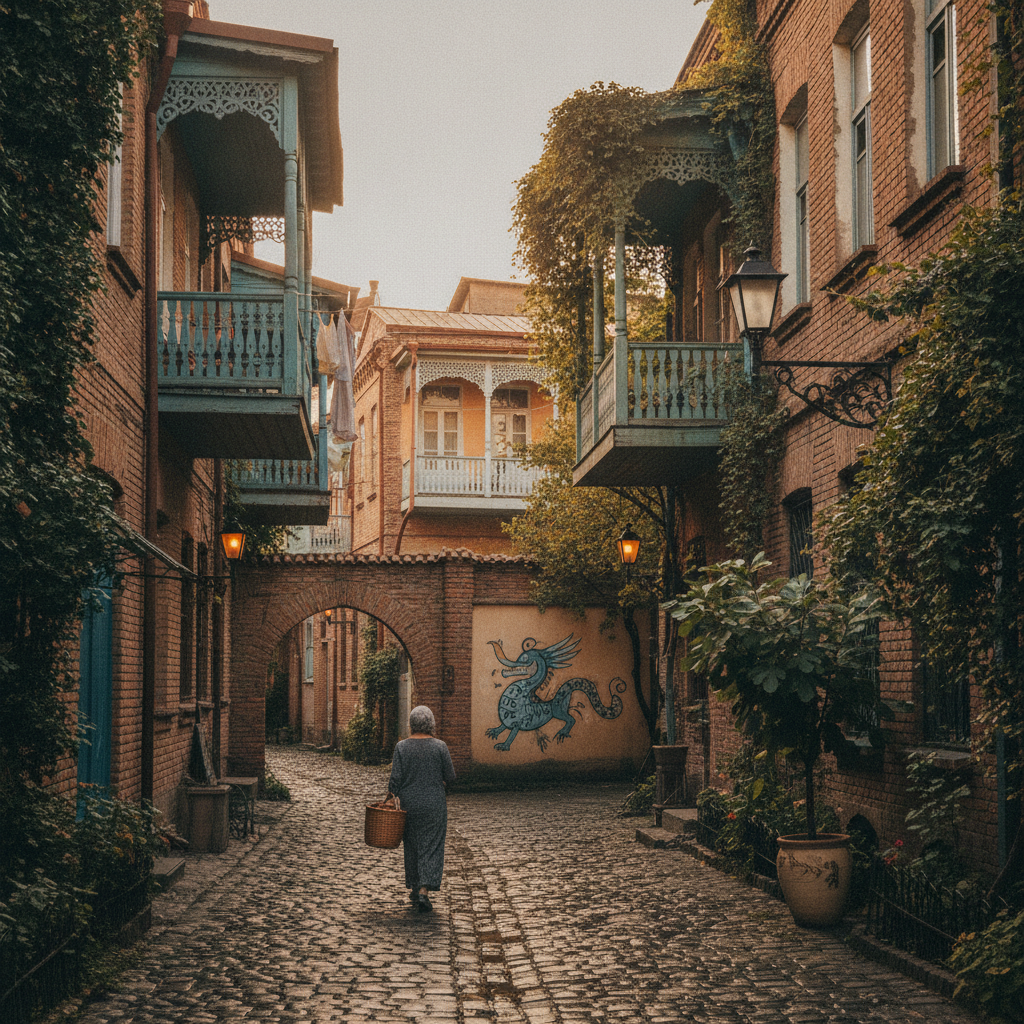
Every great city has two versions of itself — the one printed on postcards, and the one that only reveals itself to those willing to slow down. Tbilisi, the capital of Georgia nestled between the Caucasus Mountains and centuries of layered history, belongs firmly in that second category. Its old town draws visitors with sulfurous bathhouses and ornate balconies, and rightly so, but the city's real texture lives in quieter corners: in the smell of churchkhela drying in a market stall, in a courtyard where three generations of one family share a Sunday meal, in a wine bar where the bottles contain nothing from France or Italy. Forty-eight hours is not a long time, but it's enough to feel the difference between touring a city and actually meeting it.
The Architecture of a Slower Morning
Tbilisi rewards those who resist the urge to arrive with an itinerary. The neighborhood of Vera, a leafy, slightly faded district west of the city center, is the kind of place that feels genuinely unhurried on a weekday morning. Its streets are lined with Soviet-era apartment blocks softened by climbing vines and small independent cafés that open late and close whenever the owner feels like closing. Fabrika, a repurposed Soviet sewing factory in the nearby Chugureti district, has become a hub for local designers, coffee roasters, and artists without feeling entirely overrun — though it's best visited before noon, when the courtyard belongs more to locals grabbing espresso than to tour groups consulting maps. The morning rhythm here is leisurely, and the best thing a visitor can do is adopt it entirely.
Georgian coffee culture differs from what most Western travelers expect. The country has its own deeply rooted tea tradition, but specialty coffee has taken hold in Tbilisi with genuine enthusiasm rather than imported affectation. Small roasters have established themselves across Vera and Saburtalo, and the conversation at the counter — even when conducted across a language barrier — tends to be warm and unhurried. This is where the first hours of a Tbilisi visit are best spent: not photographing the Metekhi Church from across the Mtkvari River, but sitting with something hot and watching the city start its day at its own pace.
Wine, the Old Way
Georgia's claim to being the birthplace of wine is not marketing — it is archaeology, backed by vessels and residue dating back thousands of years. What matters for the traveler, though, is less the history lesson and more the glass in front of them. Georgian wine, particularly the amber wines made using the qvevri method — where juice ferments with grape skins in large clay vessels buried underground — tastes like nothing produced in more conventional winemaking regions. The result is textured, tannic, and slightly oxidized in a way that feels ancient without being unpleasant. Visitors who expect something resembling a Burgundy will be confused; those who come without expectations tend to become devoted.
The wine bars along Aghmashenebeli Avenue in the Marjanishvili area offer an accessible entry point, but the more memorable experiences tend to happen in smaller, unmarked places that function somewhere between a shop and someone's living room. Natural wine producers from Kakheti, Georgia's primary wine region, often ship directly to these Tbilisi outlets, and the owners are generally willing to open bottles for conversation as much as for commerce. This is supra culture in miniature — supra being the Georgian tradition of the elaborate feast, presided over by a tamada, or toastmaster, whose role is to guide the table through rounds of heartfelt toasts. Even in a small wine bar without a formal feast, that spirit of generous, unhurried hospitality tends to surface.
Eating Without a Menu in English
The most reliable indicator that a Georgian restaurant is worth entering is the absence of a laminated picture menu near the door. Places that cater primarily to locals rarely bother with translated signage, and the food inside is almost always more interesting for it. Khinkali — the pleated soup dumplings filled with spiced meat broth — are ubiquitous, but the quality varies enormously, and the best versions are found in places where they're made by hand that morning. The correct technique for eating khinkali involves holding it by the twisted top, biting carefully to capture the hot broth, and not using a fork under any circumstances. The locals notice, and they'll appreciate the effort.
Beyond khinkali, the Georgian table is full of dishes that don't travel well in translation: pkhali, cold vegetable preparations bound with walnut paste and spices; lobiani, a flatbread stuffed with seasoned kidney beans; ojakhuri, a pan of roasted pork and potatoes that arrives still sizzling. None of these require a special restaurant, a reservation, or a recommendation from a travel app. They require only willingness to walk into somewhere unfamiliar, point at what the next table is having, and accept whatever arrives with genuine gratitude.
What the Second Day Teaches You
By the second morning in Tbilisi, something shifts. The city begins to feel less like a destination and more like a place where things simply happen — where a wrong turn leads to a ceramic workshop, where a conversation started over shared bread at a market continues for an hour longer than planned. The Dezerter Bazaar, a sprawling open market near the train station, is the kind of place that resists description but rewards presence: stalls selling dried herbs, churchkhela — walnut-studded grape-juice candy that functions as both snack and energy source — fresh cheese, and wild honey sit alongside hardware vendors and secondhand clothing in a way that feels entirely organic. You don't shop at Dezerter Bazaar so much as move through it, absorbing.
Tbilisi is a city that gives more the less you demand of it. Forty-eight hours spent without a rigid plan, without the pressure of checking landmarks off a list, produces something that a perfectly executed itinerary rarely does: the quiet sense of having actually been somewhere, rather than simply passed through it. That feeling, faint but persistent, tends to linger long after the flight home — which is, perhaps, the most reliable sign that a city has done its job.