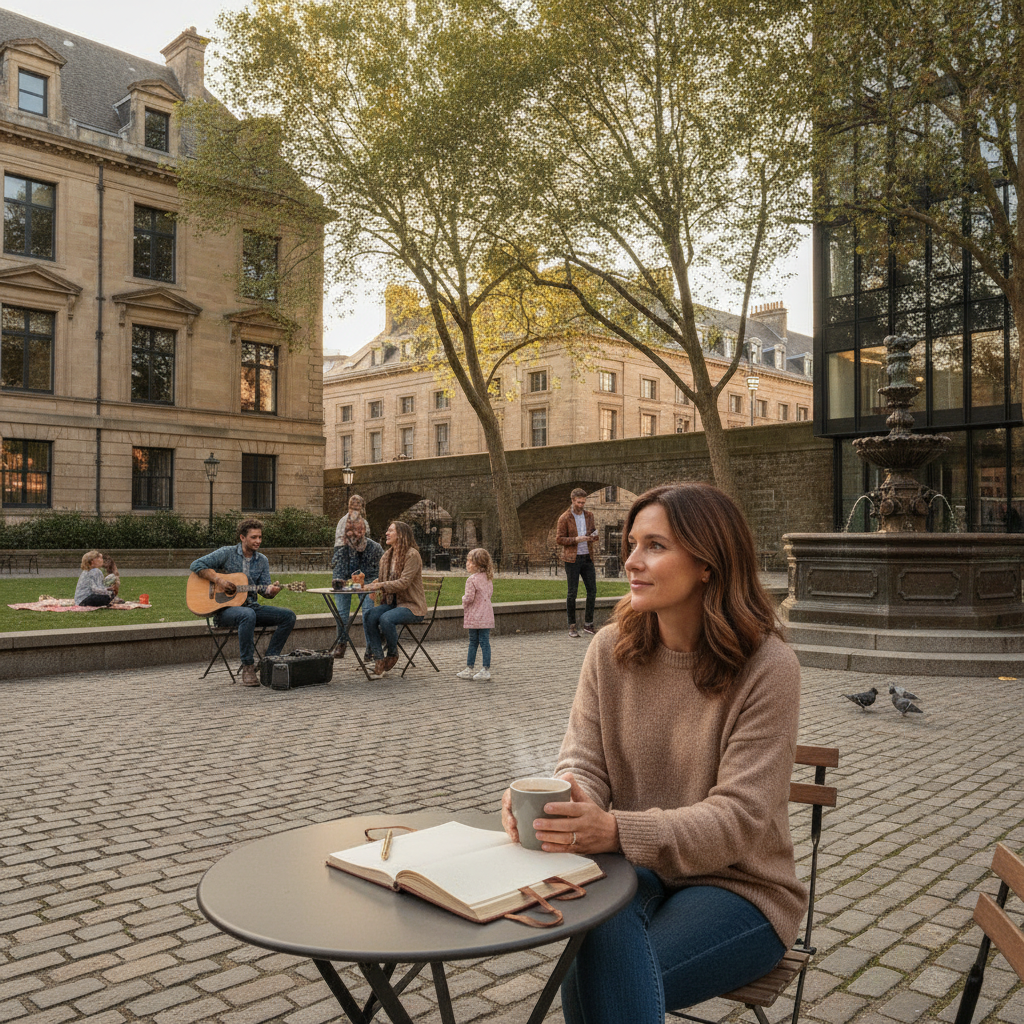
Most people know their city the way they know a familiar face — well enough to recognize it, not well enough to truly read it. They move through the same corridors of habit: the same coffee shop before work, the same park on weekends, the same three-block radius around wherever they happen to live or spend most of their time. The city beyond those edges exists as a kind of backdrop, acknowledged but never entered, familiar in name but not in feeling. What changes this isn't a grand resolution or a packed itinerary of sightseeing. It's something quieter — a single recurring hour, held with the same regularity as any other appointment, spent sitting somewhere new.
What Does It Mean to Actually Know a Place?
There's a French concept worth borrowing here: *dépaysement* — that disorienting, slightly electric feeling of being out of your usual element, of noticing that the world is wider than your routine suggests. Travelers seek it abroad, but it lives inside every city too, waiting in neighborhoods a twenty-minute bus ride away. To know a place isn't to have visited its landmarks or to be able to name its districts on a map. It's to have sat still inside it long enough for the ordinary life of that place to wash over you — the rhythm of its foot traffic, the particular quality of its afternoon light, the way strangers talk to each other at the counter of a neighborhood bakery. Knowing comes through dwelling, even briefly, and dwelling requires the willingness to stop moving.
This is precisely what the standing weekly appointment offers. Not a walking tour, not a curated exploration, but a single unambiguous commitment: once a week, sit somewhere different and stay there. The location can be a plaza in a part of town you've never spent time in, a library reading room in an unfamiliar neighborhood, a bench outside a market in a district whose name you've only seen on transit maps. The practice itself matters more than any particular destination. What accumulates over months is not a list of places visited but a layered, textured familiarity with the city as a living whole.
How Stillness Does What Movement Cannot
The instinct when exploring a new part of a city is to walk through it — to cover ground, to see as much as possible in the time available. But movement, paradoxically, keeps a place at arm's length. When you're walking, your attention is divided between navigation, physical momentum, and the processing of visual input. You skim the surface of a place rather than settling into it. Sitting reverses this completely. A person who spends ninety minutes on a bench in Istanbul's Kadıköy neighborhood, or at a corner table in a café in the Shoreditch area of East London, or on the steps of a public library in a mid-sized American city they've lived in for years, will absorb more about that place than someone who spent the same time walking a planned route through it.
Stillness invites observation that movement forecloses. You begin to notice the small choreography of daily life — the regulars who appear at the same hour, the way light shifts across a building facade, the particular mix of languages drifting through a public square. Over time, these observations build something that might be called *topophilia*, the geographer's term for an emotional bond between a person and a place. It develops not through dramatic experience but through accumulated, unhurried attention. The weekly appointment is, at its core, a practice of sustained noticing.
Why Regularity Matters More Than Variety
The temptation is to approach this practice as a form of urban tourism — to plan elaborate outings to interesting or aesthetically appealing corners of the city. But regularity matters far more than curation. The appointment works because it happens every week without negotiation, the way a standing lunch with a friend or a Friday evening call with family happens. It becomes structural, embedded in the rhythm of the week rather than dependent on mood or motivation.
What this regularity produces, over the course of a season, is a quiet shift in spatial confidence. A person who has sat in twelve different public spaces across their city in three months begins to hold a different mental map of that city — one populated not just with names and addresses but with textures, atmospheres, and a felt sense of each place's particular character. The city begins to feel genuinely inhabited rather than merely occupied. This is the difference between living somewhere and belonging somewhere, and it's a distinction that has everything to do with how much of a place you've allowed yourself to actually experience.
Where You Might Begin
For anyone drawn to try this, the most useful first step is to resist over-planning. The appointment doesn't need a theme or a narrative arc. A useful starting point is simply to identify one neighborhood in your city that you pass through occasionally but have never stopped inside — perhaps a district known for a particular community, a waterfront area you've seen from a bridge, an older commercial street that predates the city's more recent development. Go there. Find somewhere to sit — a public bench, a café with street-facing windows, a library common area, the steps of a community center. Bring nothing that demands your attention. Stay for an hour.
In cities with robust transit networks, apps like Citymapper can help identify neighborhoods that are accessible but genuinely unfamiliar. In smaller cities, the practice of simply crossing a neighborhood boundary you've never had reason to cross is enough. The specific location matters less than the commitment to sitting still inside it without agenda. Some of the most revealing sessions happen in places that seem, at first glance, entirely ordinary — a strip of small shops in a residential quarter, a park whose name you didn't know until you looked it up on the way there.
What Shifts Over Time
The change this practice produces is gradual and cumulative, which is both its nature and its gift. After several months, you may notice that you feel less like a stranger in your own city — that the quiet anxiety of unfamiliarity in new neighborhoods has softened into something closer to curiosity. You begin to hold a sense of the city as a place you genuinely inhabit, not just a backdrop to your established routines. The French call this *enracinement* — rootedness — and it doesn't require decades in a place. It requires consistent, attentive presence in it.
You may also find that the practice changes how you move through familiar parts of your city. Having spent time truly sitting inside unfamiliar corners, you start to notice more in the places you pass through every day. The street you walk along to work begins to carry more detail. The neighborhoods you thought you knew reveal layers you'd simply never paused to see. Belonging, it turns out, is less about length of residence than about depth of attention — and a single quiet hour each week, repeated with care across a year, is enough to begin building both.
The person who started with a bench in an unfamiliar district and a vague sense that the city felt large and unknowable ends up somewhere quite different — not because the city changed, but because the relationship to it did. That's the understated power of a standing appointment with yourself: it's small enough to keep and significant enough, over time, to shift how a familiar place finally feels like home.