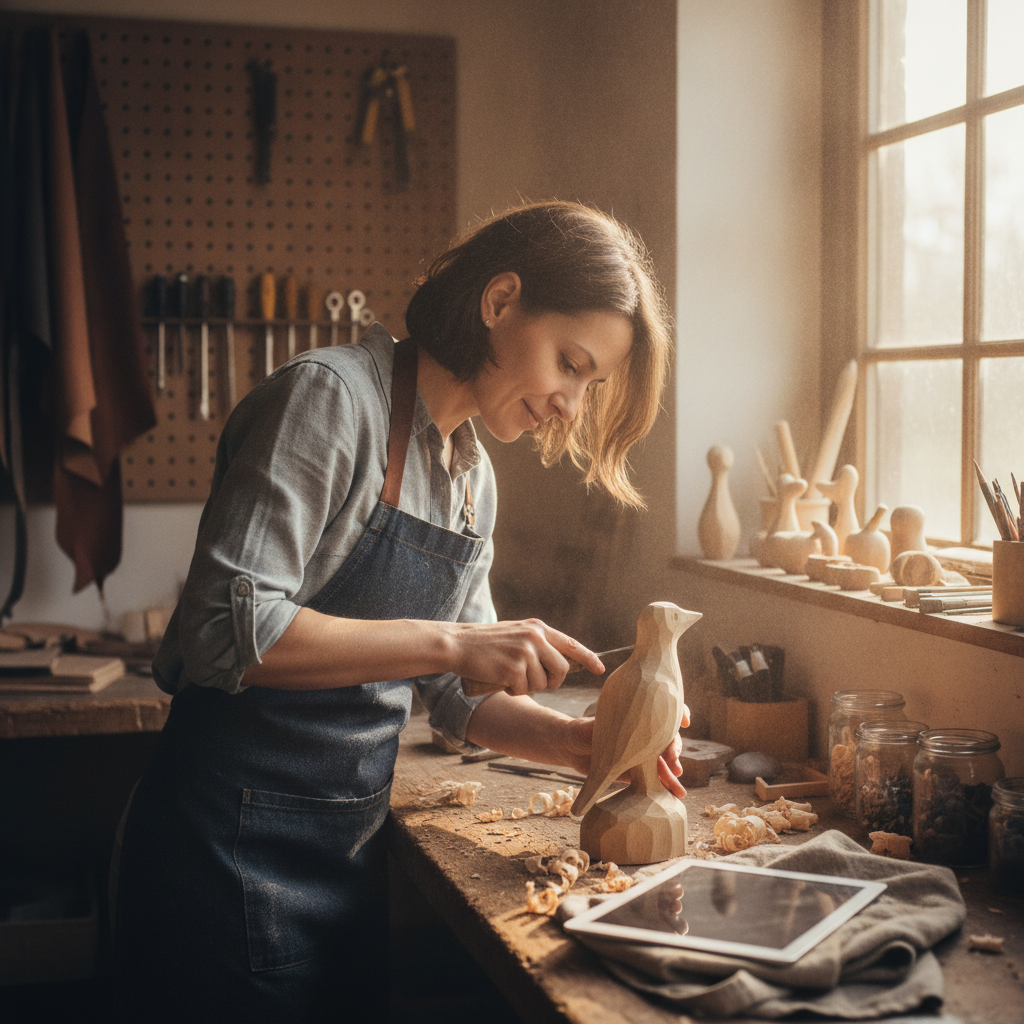
There is a particular kind of restlessness that settles in when most of what a person does each day leaves no visible trace. Work happens inside screens, communication flows through devices, and even leisure tends to unfold in the flat, frictionless space of apps and streaming. The hours pass, often productively by any reasonable measure, yet something quietly accumulates — a creeping sense that capability is narrowing rather than expanding, that the hands are becoming passengers rather than participants in daily life.
This feeling is not a personal failing. It reflects something structural about how contemporary life is arranged. But recognizing the pattern is the first step toward changing it, and the change does not require a dramatic overhaul. It requires something much more modest: one morning a month, set aside entirely for learning something with your hands.
The Particular Weight of Making Something Real
There is a concept in Japanese craft culture called *monozukuri* — the art of making things — which encompasses not just the technical act of crafting but the philosophical orientation that values creation as a form of self-cultivation. In Scandinavian tradition, the related idea of *slöjd*, a pedagogical approach to handcraft developed in the nineteenth century, held that working with materials builds character and perception alongside skill. Both traditions understood something that modern life has largely set aside: that the hands teach the mind things the mind cannot learn any other way. When a person attempts to cut a dovetail joint for the first time at a woodworking studio like those offered through community programs at places like Makeville Studio in Brooklyn, or shapes clay on a wheel at a neighborhood ceramics cooperative, they encounter resistance, imprecision, and the need for adjustment in real time. There is no undo button. The material pushes back, and the maker has to respond.
This responsiveness — this live negotiation between intention and reality — activates something that screen-based learning rarely touches. The feedback is immediate, physical, and honest. A seam does not lie. Clay either holds its form or it does not. And in that honesty, something shifts in how a person perceives their own competence.
Why One Morning a Month Is Enough to Matter
The temptation, when encountering an idea like this, is to either dismiss it as too small to count or to immediately over-schedule it into a rigorous program with goals and benchmarks. Both responses miss the point. One morning a month — roughly four hours of genuinely unstructured, tactile engagement — is enough to create a pattern of experience without creating a burden. The regularity is what matters more than the frequency. A monthly return to handwork keeps the door open in the mind, reminding the person that this dimension of life exists and is available to them.
Choosing a different skill each time amplifies the effect. One month might be spent learning basic bookbinding at a local arts center. The next might involve a sourdough baking session, following a recipe from a trusted source like the Tartine Bakery cookbook without shortcuts or substitutions — accepting the slow, unpredictable timeline of fermentation as part of the practice. Another month might bring a candle-making workshop, a lino-printing class, or an afternoon spent learning to resole a pair of shoes. The specific activity matters far less than the consistent act of returning to beginner's mind in a domain where the result exists in physical space.
What Begins to Change Over Time
The shift is not dramatic, and it does not arrive quickly. After two or three of these mornings, nothing may feel obviously different. But around the fourth or fifth, something tends to reorganize quietly in the background. The person begins to notice that they approach unfamiliar tasks with slightly less hesitation. The internal voice that previously said *I'm not the kind of person who does things like that* begins to lose its authority. This is not confidence in the conventional sense — it is not bravado or ambition. It is something calmer and more durable: a revised sense of what is possible for ordinary hands applied with patience and attention.
Psychologically, this is sometimes described through the lens of *self-efficacy* — the belief in one's own ability to complete tasks and reach goals. Handwork builds self-efficacy in an unusually grounded way because the evidence is tangible. The object exists. It was not there before, and now it is, made imperfectly but genuinely by the person who made it. That evidence accumulates across months and begins to quietly rewrite the internal story about capability.
How You Might Begin
If this practice appeals to you, the entry point is simpler than it might seem. Start by choosing a Saturday or Sunday morning — whichever is typically quieter — and treating it as genuinely protected time, the way you might protect a flight or a medical appointment. Choose something with a low barrier to entry: a local pottery studio offering drop-in wheel sessions, a natural dyeing workshop at a fiber arts collective, or even a simple candle-making kit ordered from a small maker like Candlescience that allows you to experiment at a kitchen table. The point is to prioritize materials over media, physical process over passive consumption, and patient imperfection over frictionless ease.
Tell no one what the result will look like before you begin. Resist photographing it before it is finished. Let the morning exist for the making, not the documentation. This boundary — small as it sounds — reinforces the essential quality of the practice: that some things are for the maker alone, not the feed.
Over months, the morning accumulates into something larger than itself. The person who once felt confined to what screens allowed them to do begins to move through the world with a slightly wider sense of what their own hands might accomplish. The restlessness that opened this reflection — that feeling of competence narrowing, of hours passing without trace — begins, gradually and without fanfare, to ease.