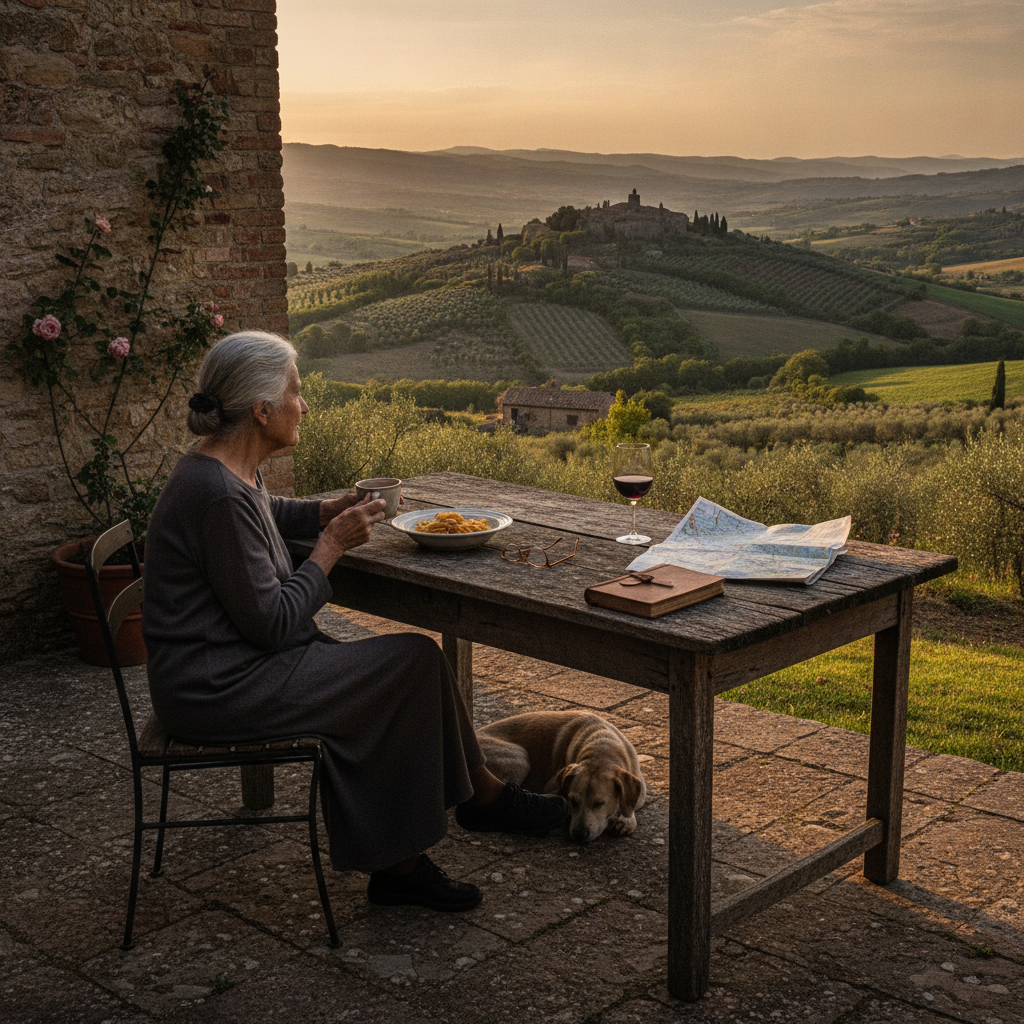
Most travelers move through places far too quickly to understand them. A day in Assisi, an afternoon in Orvieto, a morning in Spello — the itinerary fills with names, but the places themselves remain largely closed, polite facades offered to strangers who won't stay long enough to ask better questions. Umbria, that landlocked region of central Italy so often overshadowed by Tuscany to the north, rewards the traveler who resists the urge to collect destinations. Staying a full week in a single small town — say, Bevagna or Montefalco, or the quieter reaches of the Valnerina valley — teaches something that no guidebook quite manages to say plainly: places reveal themselves in layers, and most visitors leave before the second layer even begins.
The First Days and What They Conceal
The opening days of any extended stay in a small Umbrian town have a particular quality that feels, at first, like disappointment. The piazza looks the same at ten in the morning as it did at five in the afternoon. The same two cafes offer the same cornetti and the same bitter espresso. The church is beautiful but brief. Visitors accustomed to the density of a major city itinerary can feel, by the second evening, that they have already seen what there is to see. This feeling is almost always wrong, and recognizing it as a form of impatience — rather than a genuine assessment of the place — is the first real shift that a week-long stay requires. The town has not yet decided to show itself, because it has no reason to trust that anyone who arrived on Monday will still be there on Friday.
How Familiarity Changes What You Notice
By the third day, something subtler begins. The baker at the forno on the Via Roma recognizes a returning face and asks, in clipped Italian, whether the bread from yesterday was good. The woman who tends the tabaccheria pauses a beat longer before returning to her work. These are not dramatic moments of connection — they are simply what routine produces, the small social grammar of a place beginning to include a newcomer in its pattern. What changes is not the town but the traveler's perception of it. The narrow street that seemed merely picturesque on arrival begins to reveal its rhythm: the school children at half past eight, the delivery truck blocking the lane at eleven, the way the evening light hits the medieval stone in a way that has nothing to do with photography and everything to do with presence. Bevagna, for instance, has a Roman mosaic hidden beneath a modest building near its centro storico that most day-trippers never find because it isn't listed prominently anywhere. It requires asking.
Campanilismo and the Logic of Local Loyalty
Understanding Umbrian towns at any depth means encountering the concept of campanilismo — literally, the love of one's own bell tower — which describes the fierce, affectionate loyalty that Italians feel toward their specific hometown rather than toward any broader regional or national identity. In a town like Montefalco, perched above a wide valley with views stretching toward Assisi, this manifests in the quiet pride with which locals will insist that their Sagrantino wine is superior not merely to wines from other regions but to anything produced in the next valley over. Campanilismo is not parochialism in its narrow sense; it is a reminder that identity in this part of the world is intensely local, built over centuries of distinct civic history, and that understanding one town does not give you easy access to understanding its neighbor five kilometers away. The traveler who spends a week in one place begins to feel the edges of this — the way each town has its own particular tempo, its own arrangement of saints' days and market mornings, its own relationship to the land around it.
What Passeggiata Reveals That Sightseeing Cannot
The passeggiata — the slow evening walk through the town center that remains a genuine social institution in Umbrian towns, not a performance for visitors — is perhaps the single most instructive ritual a traveler can participate in during an extended stay. It happens roughly between six and eight in the evening, when families and elderly couples and teenagers cluster on the main street or circle the piazza in a loose, unhurried drift. There is no agenda to it, no destination, no product being purchased. It is purely social time organized around physical presence, and it operates according to invisible cues that become visible only after several evenings of watching. By the fourth or fifth evening of joining it — walking slowly, pausing, letting the pace of the town dictate movement rather than imposing one's own — the experience shifts from observation to something closer to participation. You begin to understand which benches belong to which groups of older men, which bar is preferred by which generation, and how the pace of conversation slows as darkness comes in from the valley.
The Slow Accumulation of a Place
There is a practical lesson embedded in all of this that applies far beyond Umbria. When you stay somewhere long enough, your relationship to it changes from consumption to something more like inhabitation. You stop asking what to see and start noticing what's there. You find the small alimentari where the owner stocks a local sheep's cheese that doesn't appear in any food writing. You discover that the church you walked past twice a day is only open on Wednesday and Saturday mornings, and that it contains a Perugino fresco that no photograph has ever quite captured fairly. You stop being a tourist in the extractive sense — taking images, checking boxes — and begin to be something more like a temporary resident, which is a quieter and more rewarding position to occupy. Spello, for example, offers this kind of gradual revelation in its flower-lined alleyways and medieval walls, but only to those who stay long enough to move past the first impression.
Finding Your Own Week-Long Town
If you are planning a trip to Umbria and considering this kind of stay, the practical question is which town rewards a full week rather than a single afternoon. The answer depends less on size than on texture — on whether the place has enough daily life to sustain curiosity. Towns with active weekly markets, working farms on their periphery, and a visible local economy that isn't entirely organized around tourism tend to give more over time. Bevagna's Roman history and its medieval Mercato delle Gaite festival preparations, which locals discuss and rehearse year-round, make it generative in this way. Smaller hamlets in the Valnerina, like Scheggino, offer a different kind of depth: fewer visitors, more exposure to the working rhythms of a landscape shaped by truffle hunting and river farming. The choice should follow your instincts about where you feel curious rather than where you feel obligated to go.
Travelers rarely forget the places they stayed long enough to actually know. A week in one small Umbrian town won't make you an authority on the region, but it will do something more valuable — it will show you how much any place withholds from those who only pass through, and how much it quietly offers to anyone patient enough to wait for it. That knowledge, once felt, changes how you travel everywhere else.