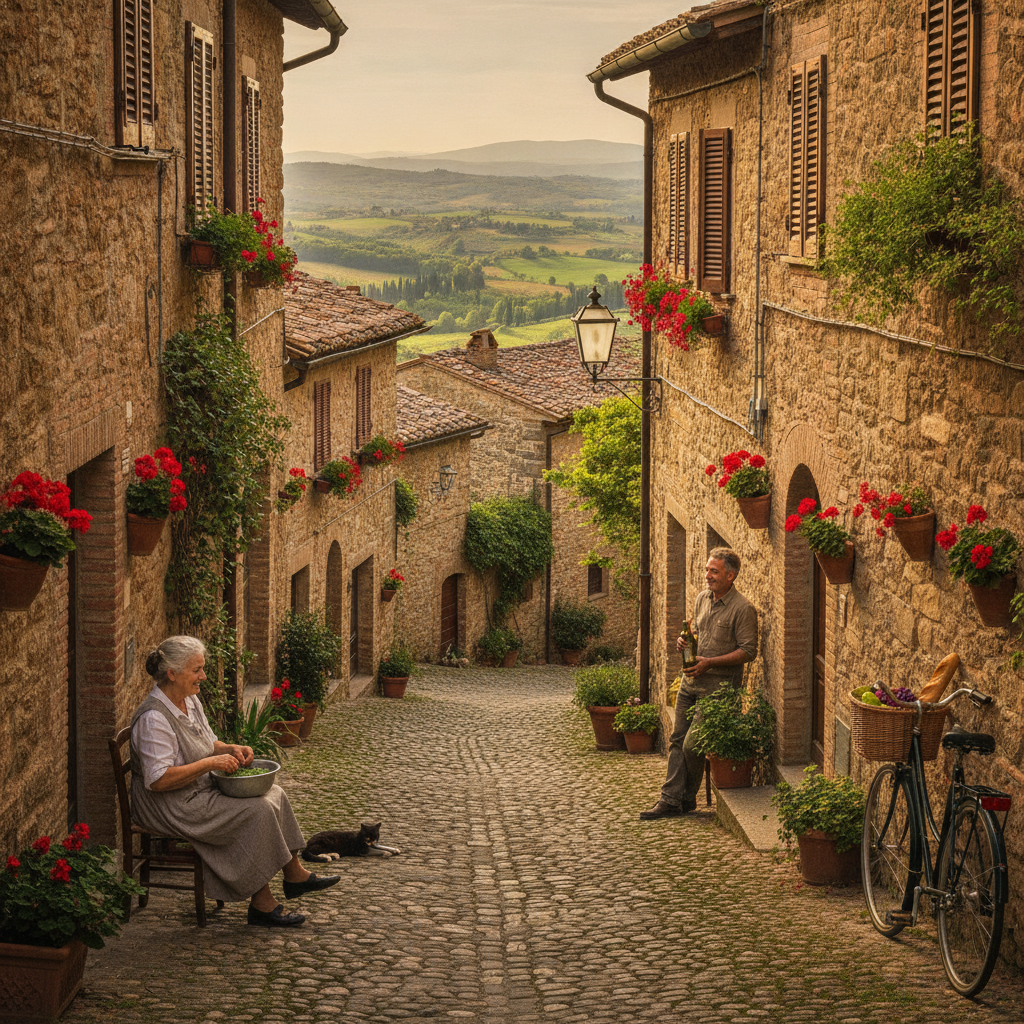
There is a particular kind of exhaustion that comes from moving through a country too quickly — the feeling of having seen everything and understood nothing. A traveler who spends seven days in Italy visiting Rome, Florence, Siena, Orvieto, and Bologna returns home with photographs and receipts but rarely with the slower, more intimate knowledge that travel, at its best, is supposed to deliver. The itinerary looks impressive on paper. The experience, however, tends to blur into a sequence of famous facades, crowded piazzas, and restaurant recommendations pulled from the same shortlists everyone else is using. Something essential about the place remains just out of reach.
What Rootedness Does to Perception
Choosing to spend a full week in a single small Umbrian town — somewhere like Spello, Bevagna, or Montefalco — changes the structure of attention itself. On the first day, a traveler notices the obvious: the medieval walls, the church on the central square, the bar where espresso costs less than it would in any tourist corridor. By the third day, something quieter begins to emerge. The rhythm of the place becomes legible. There is an understanding of when the streets fill and when they empty, which hours belong to the market and which to the midday stillness Italians call *il riposo* — the rest. That word alone carries a philosophy about time and the body that no guidebook can adequately convey, but that a week of living inside it makes genuinely comprehensible.
By the fourth or fifth day, the town stops performing for the visitor. The butcher who nodded politely on Monday is now explaining, in slow Italian and expressive gestures, which cut of pork is better for the week's weather. The elderly woman who tends the flower boxes on Via Roma offers a nod of mild recognition. These are not dramatic encounters. They are the ordinary texture of being somewhere long enough to be noticed, and they represent a form of cultural contact that a single afternoon in any city, however famous, simply cannot replicate.
The Geometry of a Small Place
Umbria itself rewards this kind of attention in ways that more heavily touristed regions of Italy sometimes don't. The region sits landlocked in the center of the peninsula, often overlooked in favor of Tuscany to the north and Rome to the south, and this relative quiet is precisely what makes it so instructive. Small Umbrian towns are not performing a version of Italy for outside consumption. They are simply themselves — functioning communities where olive oil presses operate in autumn, where the *sagra*, or local food festival, is organized by families rather than tourism boards, and where the *campanile*, the bell tower, still measures the day in a way that feels genuinely continuous with centuries of the same habit.
Spending a week in a place like Bevagna, a town of just a few thousand people in the Valle Umbra, means encountering *piazza* life as something organic rather than staged. The central square fills after the evening passeggiata — the unhurried communal walk that Italians have practiced for generations as a form of social maintenance — and the conversations happening there are between neighbors, not between travelers comparing hostels. To sit at a table on that square on a Tuesday evening is to feel the specific social gravity of a community that has organized itself around shared, unhurried presence. That feeling is not available for purchase anywhere on a five-city itinerary.
Depth Over Distance
There is a practical dimension to staying in one place that reinforces the cultural one. A traveler with a week in a single Umbrian town is not spending hours each morning repacking luggage, recalculating train schedules, or orienting to a new neighborhood's geography. That reclaimed time and energy flows directly into deeper engagement. There are day trips, certainly — Assisi is close, Perugia is reachable, the wine estates of the Sagrantino di Montefalco denomination are best explored slowly over several afternoons — but they all depart from and return to the same quiet base. The town becomes a kind of anchor, and returning to it each evening carries a satisfaction that hotel check-ins in five different cities never quite produce.
Cooking becomes possible in a way it isn't on a moving itinerary. Shopping at a local market in Foligno or Spoleto, gathering black truffles shaved fresh at a small deli, preparing a simple meal in a rented apartment — these acts of ordinary domestic life in an unfamiliar culture produce a kind of knowledge that sightseeing cannot. Food in Italy is not a theme. It is an organizing principle of daily life, and the only way to understand that is to participate in it as daily life rather than as a series of restaurant reservations.
What You Carry Home
When you return from a week spent in one small Umbrian town, what you carry home is different in kind from the souvenirs of a whirlwind itinerary. There are no frantic final purchases at airport shops, no half-remembered museums blurring together in memory. Instead, there is something more like a felt sense of a place — the specific quality of light on stone walls at five in the afternoon, the way conversation at a bar sounds different on a weekday morning than it does on a Sunday, the particular hospitality of a region where tourists are still occasional enough to be genuinely welcomed rather than efficiently processed. Italy has always offered this to those who slow down long enough to receive it. A single week in one small town, it turns out, is exactly long enough — and it tends to change how a traveler thinks about every trip that follows.
The traveler who began by moving quickly through five cities, accumulating images and checking landmarks off a list, eventually recognizes what that approach was trading away. Not experience, exactly — those five cities offered plenty — but depth, recognition, and the specific pleasure of a place becoming familiar. A week in Spello or Montefalco gives back what speed takes away, and the understanding it produces is the kind that doesn't fade the way photographs do.