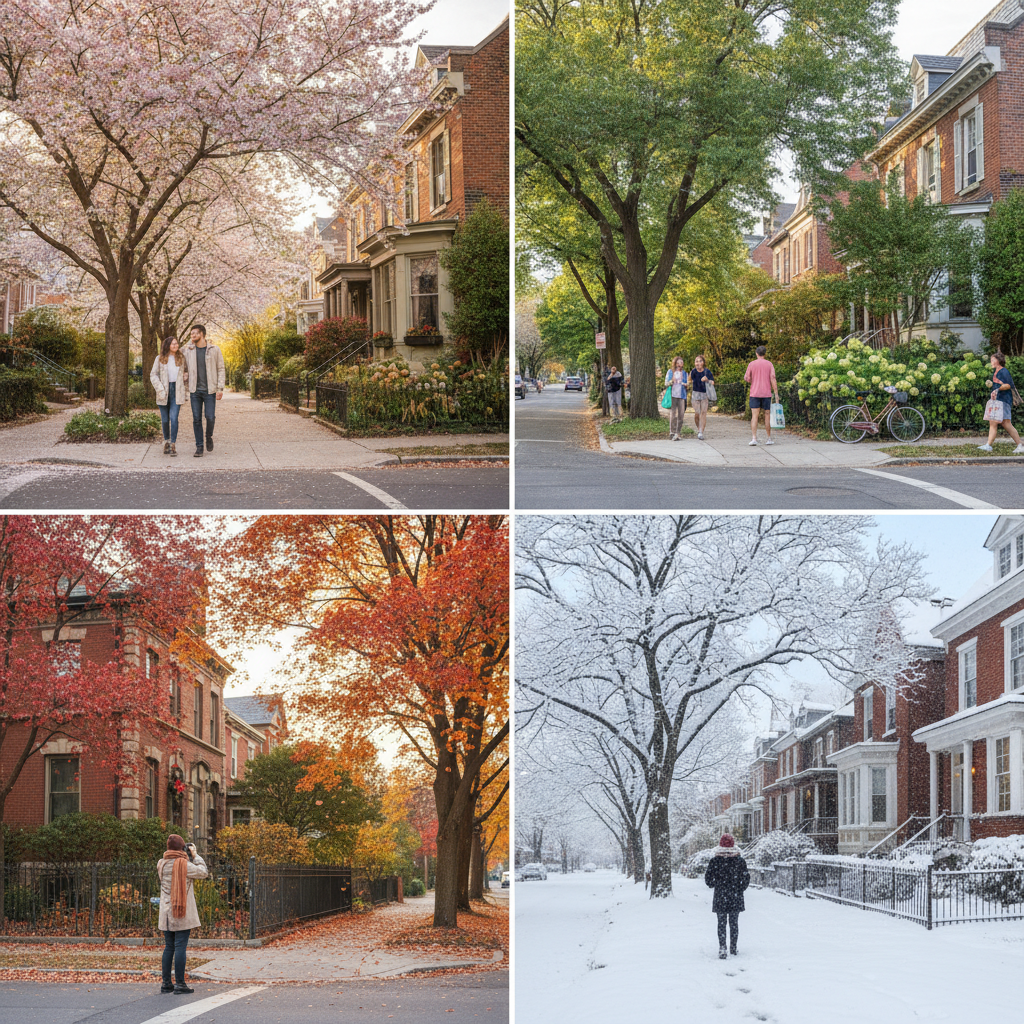
Most people know their city the way they know a frequently visited website — by the routes they take to reach what they already want. The commute, the grocery run, the familiar restaurant on the corner of the street they have lived near for years: these paths form a kind of mental shorthand that makes daily life efficient but gradually narrows the felt sense of a place. The city becomes backdrop rather than texture, something to move through rather than something to inhabit. And yet, just beyond the edges of those worn routes, entire neighborhoods carry their own rhythms, architectures, and cultural logics — waiting not for discovery in the tourist sense, but for the simple attention of a person willing to slow down and walk.
The Geography of Habit and What It Quietly Costs
Urban psychologists and anthropologists have long observed that human beings develop what might be called cognitive maps — internal representations of space shaped entirely by experience rather than geography. A person who drives through the Pilsen neighborhood of Chicago every few weeks without stopping builds a cognitive map of that area that consists almost entirely of a corridor of passing impressions: a mural glimpsed at a stoplight, a taqueria sign, the general texture of low brick storefronts. The actual neighborhood — its community gardens, its gallery spaces, the covered walkways where residents gather on warm afternoons — remains invisible, not because it is hidden, but because the pace of passage never allowed it to register. Repetition at speed produces familiarity without knowledge, and over time, that false familiarity makes a place feel already known when it has barely been touched.
This compression of experience happens in cities everywhere. In Lisbon, visitors and long-term residents alike often confine themselves to Alfama and Bairro Alto while entire bairros like Mouraria — historically one of the city's oldest and most culturally layered districts — pass by as a name on a map. In smaller cities, the dynamic is often even sharper: the older residential streets east of the downtown core, the commercial stretch on the far side of the rail line, the mixed-use blocks that developed quietly in the 2010s and now house independent bakers, repair shops, and community gardens. These places exist in full, vital detail. They simply require a different relationship to time.
What Walking Slowly Actually Activates
There is a concept in French called the *flâneur* — a term associated with the cultural critic Charles Baudelaire and later Walter Benjamin — which describes a particular kind of urban wanderer: someone who moves through city streets without destination, attending to detail for its own sake, treating the street itself as a form of reading. The flâneur is not a tourist taking photographs of landmarks. The flâneur notices the worn brass handle on a door that has been opened ten thousand times, the sound of a language spoken in a courtyard behind a wall, the way afternoon light settles differently on a block of older buildings than on newer ones beside it. This quality of attention is not exotic or difficult — it is simply what the body naturally begins to do when it is no longer required to arrive somewhere quickly.
Walking activates this mode almost automatically. Without the visual tunnel that driving creates, the peripheral field opens. Without the pressure of arrival, the pace adjusts to interest rather than destination. The shops people notice on foot are different from those they register from a car: the smell of a bakery, the texture of a handmade sign, the small park tucked behind a church that appears on no map they have ever consulted. Each of these details is a form of data about how a place actually lives — data that speed consistently filters out.
How One Seasonal Walk Reshapes a Full Year of Perception
Choosing one afternoon per season — autumn, winter, spring, summer — to walk through a neighborhood the rest of the year passes by is not a grand commitment. Four afternoons across twelve months is a modest investment. What makes the practice surprisingly potent is its rhythm. When the same area is visited across seasons, the neighborhood begins to reveal itself in layers. The empty lot that seemed unremarkable in October has become a community market in April. The café that was shuttered in January has opened by June and is now drawing a lunchtime crowd that reframes what that block is for. The seasonal variation creates a kind of ongoing narrative, and narrative produces attachment where distance once existed.
This is how long-term residents actually come to feel at home in a place — not through a single visit, but through accumulated return. The practice of seasonal walking borrows that quality of relationship and applies it deliberately, even to neighborhoods one does not live in. The Brooklyn neighborhood of Bushwick, for instance, changes substantially across seasons: its outdoor murals read differently against winter grey than summer heat, its weekend market appears only in warmer months, and the energy of its streets shifts in ways that no single visit can fully capture. Returning four times — once in each season — produces a relationship that feels more earned, and therefore more real.
Making the Practice Work Without Overplanning
The most important structural feature of a seasonal neighborhood walk is the absence of an itinerary. Apps like Google Maps or Citymapper can be useful for getting to the starting point of an unfamiliar area, but once there, the phone ideally goes into a pocket. The purpose is not to locate specific attractions but to follow curiosity: turn down the street that looks interesting, pause in front of the building whose architecture seems out of keeping with its surroundings, sit for twenty minutes in a park that has nothing particularly notable about it except that it exists and people are in it. The resistance to documentation — to photographing and cataloguing rather than simply experiencing — is worth practicing.
Choosing a neighborhood with genuine daily-life infrastructure tends to produce more rewarding walks than choosing one known primarily for its restaurants or nightlife. Streets with hardware stores, laundromats, community notice boards, small worship spaces, and corner vendors operating in multiple languages offer a more textured sense of how the city actually functions at its residential and commercial core. In most mid-sized to large cities, these neighborhoods are rarely more than a fifteen-minute drive from wherever someone already lives.
What Begins to Shift After a Year of This Practice
For you, the change may be subtle at first — a loosening of the assumption that you already know your city, a growing awareness that the place you have lived in for years is stranger and more interesting than you had allowed yourself to believe. Over the course of a full year, something quieter begins to happen. The city stops feeling like a fixed quantity and starts feeling like a place still in the process of being understood. That shift has an effect on daily life that goes beyond the walks themselves. Streets driven past on the way to work begin to carry more weight because you have learned, through practice, that weight is what they hold. The familiar route to the grocery store in Andersonville or along Richmond's Carytown strip becomes less automatic and more observed, because walking has trained attention in a way that accumulates.
The city, it turns out, was never background. It was always a text — layered, particular, and far longer than any single habitual reading of it could suggest. All that was ever needed was a slower pace, a single afternoon, and the willingness to arrive somewhere without already knowing what it is.