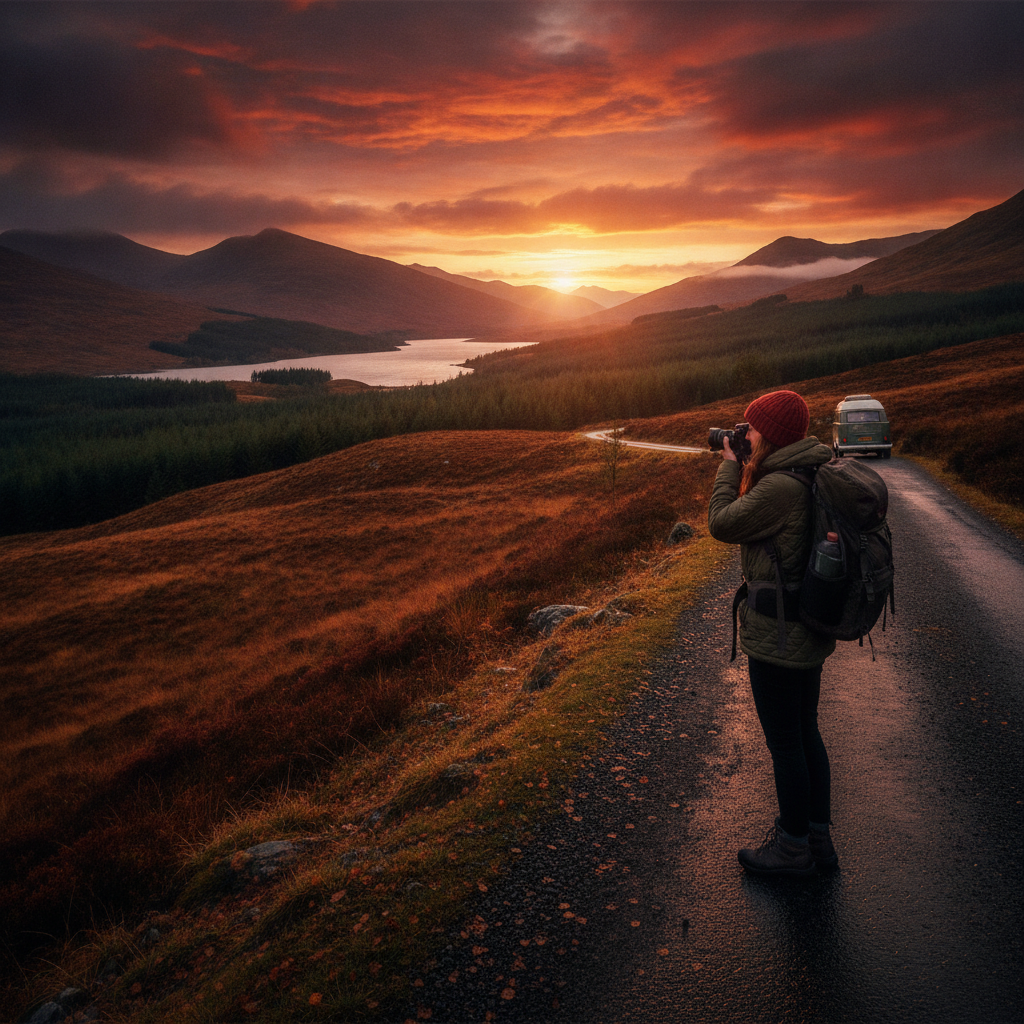
There is a particular kind of solitude that only certain landscapes can offer — not the absence of people, but the presence of something larger and older than ordinary life permits. The Scottish Highlands in late autumn deliver this feeling with an almost uncanny consistency. The crowds that trace the North Coast 500 in summer have long since retreated. The light arrives low and golden even by mid-morning, and by three in the afternoon it is already pulling away, casting long shadows across the moorland. For the solo traveller willing to trade comfort for atmosphere, there are few experiences on this earth quite like arriving in a village of forty people at dusk, with nothing on the schedule and nowhere else to be.
The Rhythm of an Autumn Highland Day
Late autumn in the Highlands — roughly October through November — imposes its own quiet structure on the solo traveller. Days are short, often running no more than seven or eight hours of usable daylight, which forces a kind of intentionality that longer summer days rarely demand. The traveller wakes early, not from ambition, but because the light is already doing extraordinary things to the water and the hills, and missing it feels like a small personal failure. Breakfast in a Highland guesthouse, particularly in towns like Ullapool or Tongue, tends to be a generous, unhurried affair — local eggs, dense bread, sometimes smoked fish — eaten in near silence at a table near a window glazed with condensation. The day then opens like a series of choices made in real time, with no itinerary pressing from behind.
Moving through the landscape on foot or by car has an almost meditative quality in this season. The heather has largely faded to rust and amber, and the bracken has gone fully bronze. Lochs reflect sky in ways that seem physically impossible, doubling the cloud formations above into perfect mirror images below. The midges — those relentless tiny biting insects that make summer hiking a genuine ordeal — are entirely absent. The rain, when it comes, tends to arrive horizontally and with conviction, which simply means the waterproof jacket earns its weight and the flask of tea earns its gratitude.
What Solitude Teaches in This Particular Landscape
Travelling solo through the Highlands in this season is not simply about sightseeing. It becomes, almost unavoidably, an exercise in paying attention. Without a companion to share observations with, the mind turns its focus outward more completely. The lone red deer standing at the edge of a forestry track near Beinn Eighe becomes a moment that is entirely one's own — unmediated, unnarrated. The strange acoustic quality of a glen in still weather, where small sounds carry improbable distances, starts to feel less like a curiosity and more like a feature of the place worth sitting with. Scottish Gaelic has a word, *ciùin* (pronounced roughly *kyoon*), meaning a gentle, peaceful calm — and it describes the particular quality of stillness that settles over the glens on dry autumn afternoons with unusual precision.
This kind of reflective attention changes the quality of the experience in ways that are difficult to account for until they are already happening. There is no pressure to agree on where to stop, no compromise on pace. The traveller who wants to spend forty minutes watching the light move across a hillside simply does. The one who wants to drive another thirty miles before deciding whether to stop does that instead. The Highlands in late autumn reward this kind of unhurried curiosity — the landscape is too vast and too varied to be consumed efficiently, and it seems to actively resist any attempt to do so.
Practical Realities Worth Knowing Before You Go
The solo traveller who arrives in the Highlands without some practical preparation will find the season's pleasures complicated by avoidable friction. Many smaller guesthouses, independent cafes, and local pubs in remote villages operate reduced hours or close entirely by November. The village shop in Kinlochbervie or Lochinver may be the only source of food for twenty miles in any direction, and its hours are not always posted reliably online. Booking accommodation a few days ahead — rather than weeks, since competition is low — is a reasonable middle ground that preserves flexibility without courting the risk of arriving at a locked door after dark. Fuel is another consideration: petrol stations are sparse on routes like the road between Lairg and Durness, and gaps of sixty miles between reliable stops are not unusual.
Car hire from Inverness is the most practical entry point for most visitors, though the trains from Glasgow and Edinburgh into Inverness offer one of the more quietly spectacular rail journeys in Europe. Driving in the Highlands means navigating *single-track roads* — narrow lanes with occasional passing places marked by white diamond signs, requiring a particular etiquette of patience and eye contact with oncoming drivers that most visitors adapt to quickly. Mobile signal is intermittent at best across much of the interior, which most solo travellers find either alarming or liberating depending on their relationship with connectivity.
Finding Connection in an Empty Season
There is a misconception that solo travel through a quiet landscape in an off-season must be lonely. The Highlands in late autumn challenge that assumption. The relative scarcity of other tourists creates an odd intimacy with the locals who remain — the guesthouse owner who recommends a hidden walk along a sea loch not marked on any tourist map, the farmer who waves from a quad bike and somehow conveys genuine warmth in the gesture, the barman at a pub in Dornoch who has strong opinions about whisky that he shares without being asked. These small exchanges, which would be entirely ordinary in a different context, feel weighted and memorable against the backdrop of the empty landscape.
When you arrive in a village that feels half-asleep and you settle into a chair by a fire with a glass of something warming, the thought arrives quietly that this is what you actually came for — not the photographs, not the dramatic views, though those are real enough, but this specific quality of unhurried presence. The Highlands in late autumn don't perform for visitors. They simply continue being themselves, which turns out to be more than enough.