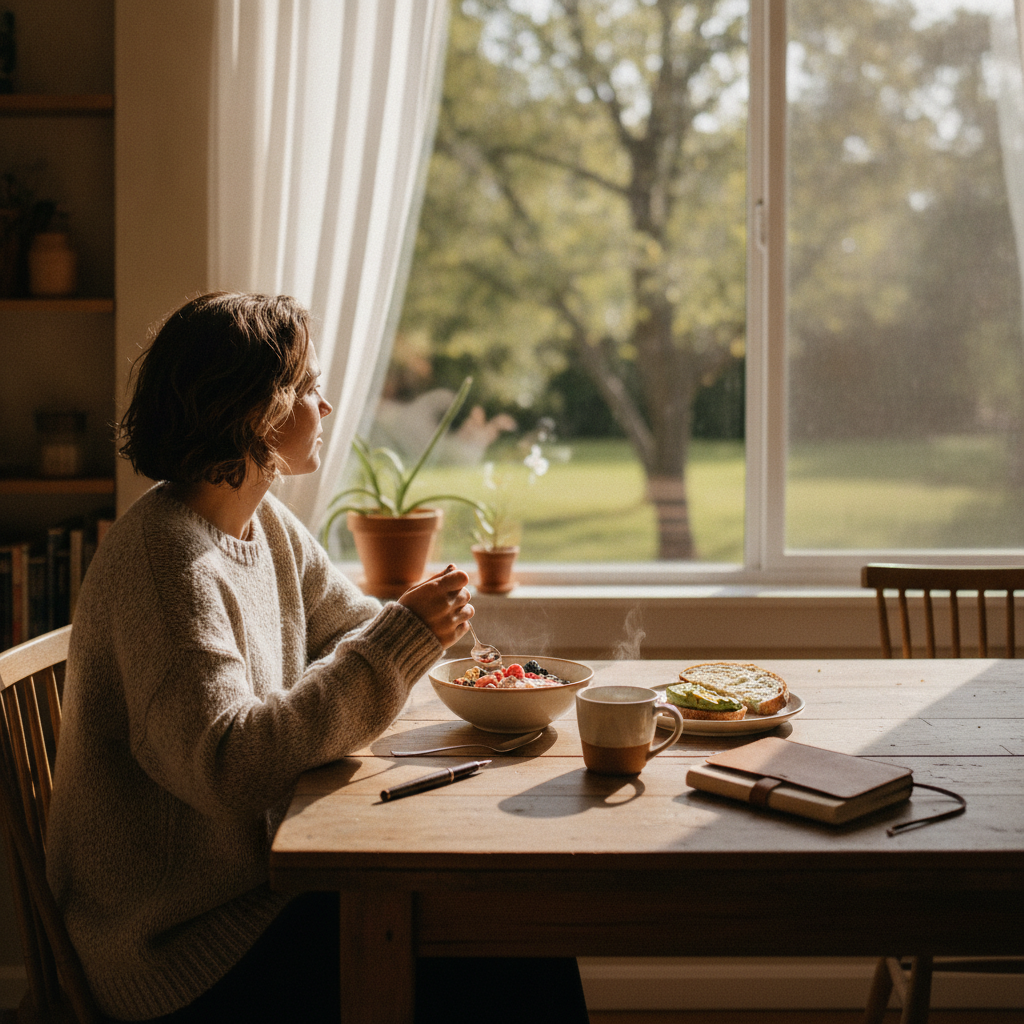
Most people spend their weekends in a low-grade rush. Even without meetings or deadlines, the mental habit of productivity follows you into Saturday morning — scanning your phone before you're fully awake, building mental to-do lists while the coffee brews, eating standing up because sitting down feels like falling behind. The irony is that the very hours meant to restore you can quietly keep you running on the same exhausting frequency as the rest of the week.
What changes when you set aside one morning — not both, just one — to make breakfast slowly, eat it without an agenda, and resist the pull to do anything else while it's happening? Quite a lot, it turns out. Not immediately, and not dramatically. But over weeks and months, this small ritual tends to loosen something that most people didn't realize had gotten stiff: your capacity to simply be somewhere without needing to make it useful.
Let the Preparation Itself Be the Point
The cooking matters as much as the eating. When you make breakfast slowly — cracking eggs without rushing, toasting bread while standing still instead of tidying the counter at the same time — you're giving your hands something to do that doesn't require your full cognitive attention. That's actually rare. Most tasks demand focused thinking, and most rest involves passive consumption. Slow breakfast preparation occupies a middle space that's genuinely calming. Brands like Le Creuset and ceramic pan makers in the Lodge tradition design their cookware partly around this kind of unhurried, sensory engagement. There's a reason cooking feels meditative when you let it.
Eat at a Table, Not a Counter or Couch
Where you eat shapes how you eat. A counter encourages standing, grazing, finishing quickly. A couch pairs naturally with a screen. But sitting at an actual table — even a small one in a studio apartment — signals to your nervous system that this meal has a dedicated place and a modest formality worth honoring. You don't need a dining room in a Parisian apartment to get the effect. A two-person kitchen table works perfectly. The physical act of setting a place, even simply, creates a soft boundary between the meal and everything waiting on the other side of it.
Leave Your Phone in Another Room
This one is harder than it sounds, which is exactly why it deserves its own section. The phone doesn't have to be doing anything for it to fragment your attention — its mere presence on the table raises the likelihood that you'll check it. Researchers who study attention patterns have documented this consistently. During your slow breakfast morning, putting the phone in a bedroom or on a charger in a hallway isn't a punishment. It's an experiment in finding out what your mind does when it has nowhere to go. The first few times, it might feel restless. That restlessness is worth sitting with.
Choose Food That Requires Presence to Appreciate
This isn't about elaborate cooking. It's about choosing things that reward attention. A properly ripe avocado on good sourdough from a local bakery like Tartine in San Francisco or a neighborhood equivalent wherever you live. Soft-boiled eggs timed carefully. French press coffee made with water heated to the right temperature. These small acts of precision aren't perfectionism — they're invitations to notice. When the food is worth paying attention to, you have a natural reason to slow down without forcing it. The quality of the ingredients becomes a gentle anchor for your presence.
Resist the Urge to Plan the Rest of the Day During Breakfast
The mind will try to use the quiet productively. It will surface the grocery run, the email you forgot to send Friday, the social obligation you need to schedule. This is normal — your brain has been rewarded for this kind of anticipatory planning all week. Gently returning your attention to the meal, the texture of the food, the light coming through the window, is not about suppressing those thoughts. It's about practicing the choice not to follow them immediately. Over time, this practice builds what might be called voluntary patience — the ability to let unstructured time exist without immediately trying to fill or optimize it.
Notice What Happens After Breakfast, Not Just During It
The effects of a slow, agenda-free breakfast morning often show up in what follows it rather than during the meal itself. People who build this habit frequently report that the hours after feel qualitatively different — less reactive, more spacious. There's a natural momentum to presence: spending forty minutes without rushing tends to carry forward into a morning walk taken at an actual stroll, a book picked up without the intention to finish it, a conversation with a partner or housemate that isn't about logistics. Apps like Calm or Headspace describe something similar in the context of meditation — the practice isn't just the session, it's the residue it leaves.
Do It Consistently Enough to Feel the Accumulation
One slow breakfast won't restructure your relationship with free time. But six or eight of them, spaced across a couple of months, will begin to. Consistency here doesn't mean rigidity — it means returning to the practice even after a weekend where it didn't happen, or where you started it and drifted back to your phone halfway through. What accumulates isn't a skill exactly, but a kind of familiarity with unstructured time that gradually makes it feel less uncomfortable and more genuinely restorative. You start to recognize what rest actually feels like, as distinct from distraction.
Protect It Like a Commitment, Not a Luxury
The easiest way to lose this practice is to treat it as optional in a way that means it rarely survives contact with a busy Saturday. Protecting one slow breakfast morning each weekend — deciding in advance which morning, telling household members so expectations are aligned — is what moves it from a nice idea to something that actually changes how you experience your own time. Think of neighborhoods like Portland's Sellwood district or Brooklyn's Carroll Gardens, where weekend mornings at small cafés have a cultural weight, a shared understanding that this hour belongs to something slower. You can build that same understanding into your own home.
The restlessness that greets you the first time you sit down to breakfast without an agenda, without a screen, without anything to accomplish — that restlessness is the thing worth meeting. It's telling you how little practice you've had at simply occupying your own time without turning it into something. One morning, one meal, one quiet hour at a time, the relationship between you and unstructured time can shift from anxious to genuinely open. And that shift tends to spread further than breakfast.