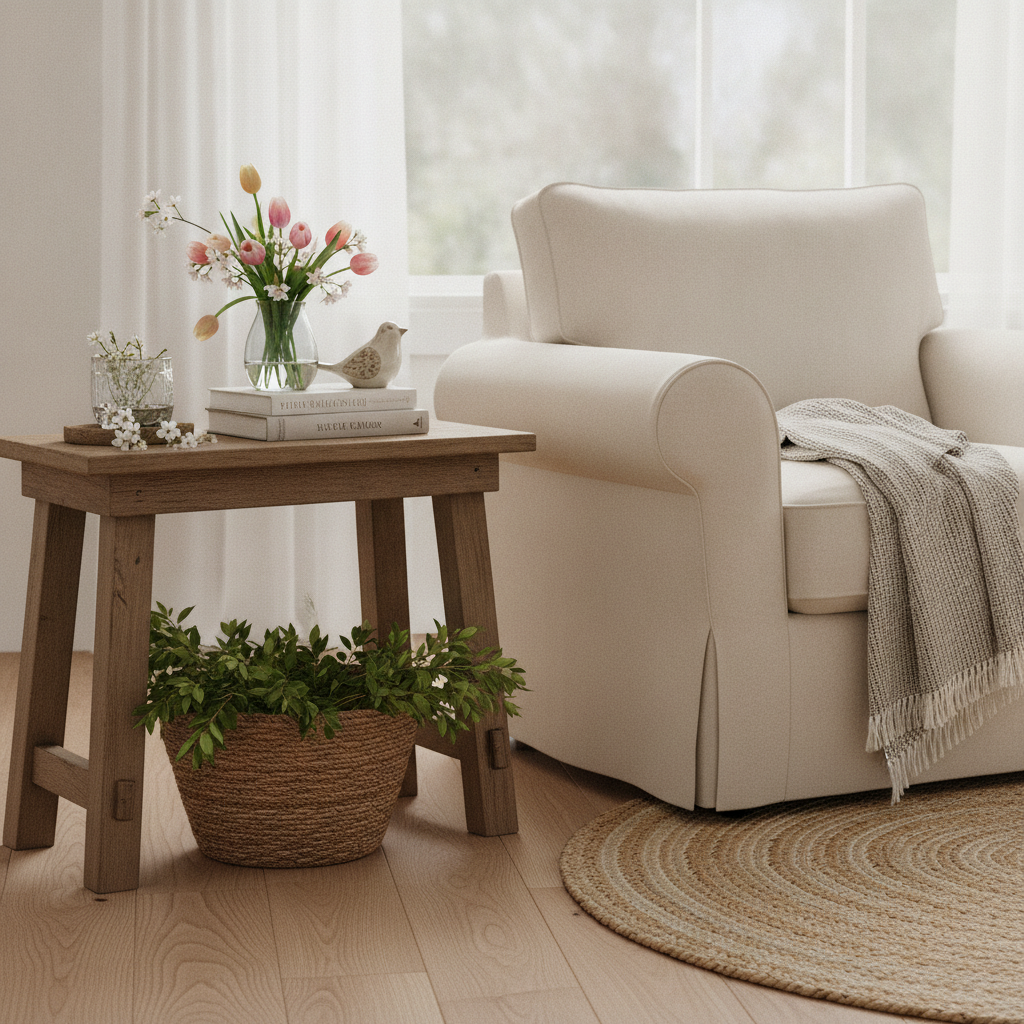
There's a particular feeling that settles over a room when nothing in it has changed for months — a quiet staleness that has nothing to do with cleanliness or care, but everything to do with familiarity. The eye stops registering what it has already catalogued, and the space that once felt considered begins to feel simply fixed. Most people respond to this feeling by assuming they need to redecorate, which sets off a cascade of decisions, purchases, and disruptions that rarely feel worth the result. The simpler answer, and the one that holds up season after season, is far more modest: one corner, four times a year, a small rotation of objects you already own.
Choose Your Corner and Commit to It
The practice begins not with shopping but with selection. Every living room has a corner or surface that functions as a quiet focal point — a shelf beside a window, a console table near the entry, a low credenza beneath a framed print. This is the spot that naturally draws the eye when someone walks into the room, and it's the only place that needs to change. Committing to one dedicated zone keeps the practice sustainable and prevents it from expanding into a full-room overhaul every few months. The rest of the room can remain exactly as it is.
Once the corner is chosen, the next step is taking stock of what already exists in the home — objects tucked into closets, items stored in bins after last season, things that were loved briefly and then forgotten. Ceramics, candles, small plants, textile throws, wooden objects, woven baskets, a single piece of framed art that hasn't had a home in a while. The goal isn't to curate a perfect collection but to gather enough variety that the rotation feels genuinely different each time rather than slightly rearranged. Three to five objects per season is usually enough.
Build Your Seasonal Inventory With Intention
Thinking in quarters gives the practice a clear rhythm. Spring calls for lighter textures and fresher tones — linen, soft greens, small botanicals, or a clear glass vessel with a single stem. Summer can lean into warmth without heaviness: a sun-bleached wooden object, a woven tray, something with natural fiber or a warm amber hue. Autumn is the easiest season for this kind of curation, given how naturally objects like dried grasses, amber glass, terracotta pots, and layered textiles communicate the shift in light. Winter asks for softness and depth — a thick ceramic, a candle in a muted tone, a small evergreen sprig in an understated vase.
The objects don't need to be purchased new each season. In fact, the practice works better when it draws from a small, rotating inventory that you've deliberately assembled over time. Apps like Sortly can help with tracking what you own and where it's stored, which sounds overly systematic until the third winter you've forgotten that the perfect brass candleholder is somewhere in a hall closet. Keeping a brief note — even a photo in your phone's camera roll — of what the corner looked like during each previous season helps avoid repetition and sparks ideas for what might work next time.
Time the Rotation to Natural Transitions
The most effective moment to rotate the corner isn't the first day of the meteorological season but rather the point at which you first notice the room beginning to feel out of sync with the world outside. In practice, this usually falls a week or two before the season fully arrives — when the light starts shifting, when the temperature makes a perceptible turn, when you reach for a different kind of coat in the morning. Responding to that internal cue rather than the calendar keeps the practice feeling intuitive rather than mechanical.
Planning the rotation even loosely in advance makes it far easier to execute in under an hour. An app like Notion or the simpler Apple Notes works well for this — a running seasonal list of objects to pull out, a rough arrangement sketch, and a reminder set two weeks before each quarter turns. The preparation takes ten minutes; the actual rotation takes perhaps thirty. The result is a room that feels genuinely refreshed without a single new purchase.
Let the Corner Do the Work the Room Can't
When the rest of a room is stable and well-arranged, a single changed corner carries a disproportionate amount of perceptual weight. The eye moves to contrast and novelty instinctively, so a small cluster of objects that has been deliberately swapped out registers as meaningful change even when everything around it is identical. This is the quiet visual logic behind the practice — you're not fooling the room, you're working with how attention actually moves through a space.
Designers who work in residential interiors often refer to this as the power of the vignette: a composed arrangement of three to five objects that reads as intentional rather than accumulated. Platforms like Pinterest and Houzz are genuinely useful here, not for copying ideas directly but for training your eye toward what makes a small arrangement feel considered. A variation in height, a mix of textures, one object that carries a personal association — these small decisions accumulate into something that feels, without any fuss, like a room that's alive to the season it's in.
Resist the Impulse to Overcomplicate
The seasonal corner works precisely because it asks so little. Three objects, one surface, four times a year. The moment the practice begins to feel like a project — when it requires purchasing things, reorganizing shelves, or updating multiple areas of the room — it loses the very quality that makes it worth returning to. Constraints are what make it sustainable. A single corner, a small inventory, a gentle quarterly rhythm.
There's something quietly meaningful in the fact that a room can feel genuinely new again without a single thing being replaced. The objects were always there. They were simply waiting for the right season to come back into the light — and so, in a small way, were you. As the year moves forward and each quarter brings its own shift in texture and tone, that corner becomes less a decorating exercise and more a habit of attention: a reminder that the spaces we live in respond to care, to intention, and to the simple pleasure of noticing what season it actually is. If one corner of the room is ready to change, now is a good time to think about what the next quarter calls for.