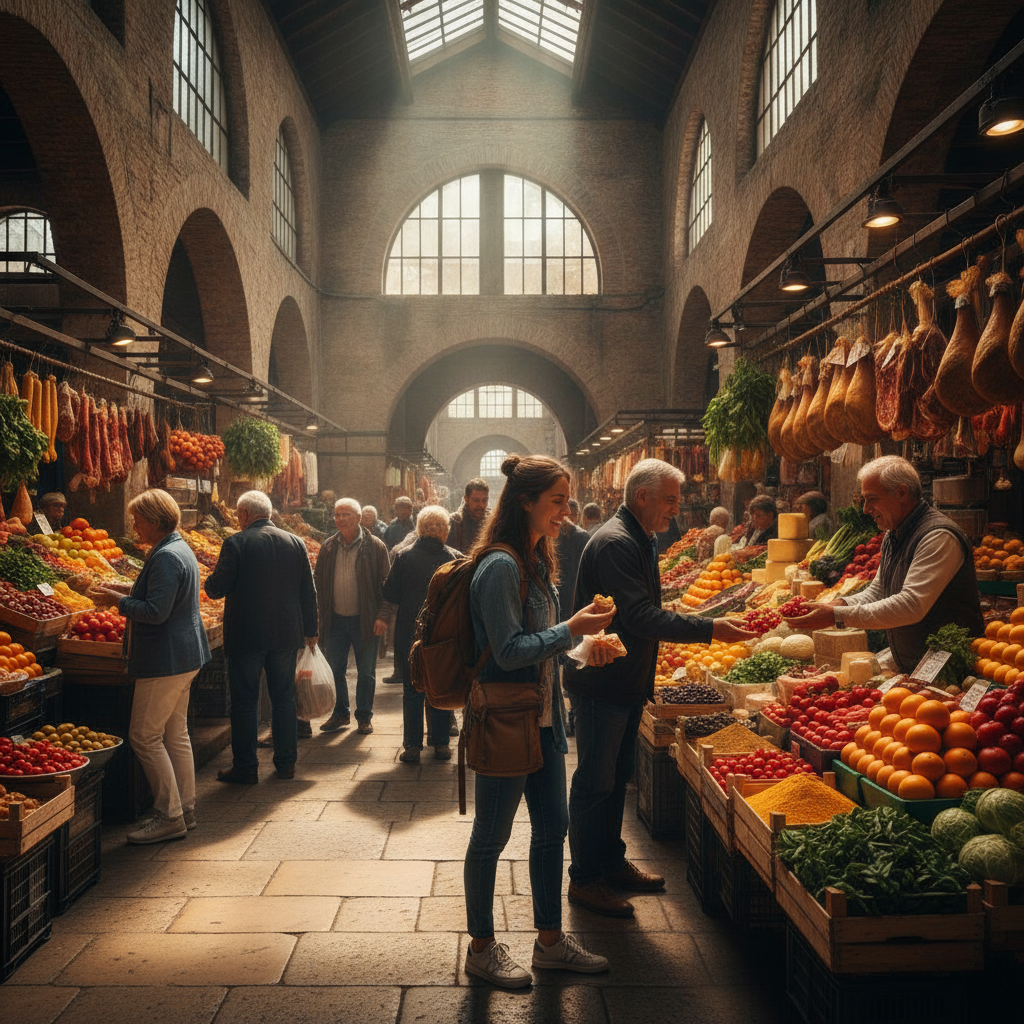
There is a particular kind of disorientation that arrives with a new city — the jetlag of unfamiliarity, the sense that the place has a pulse you haven't yet learned to read. Streets that don't follow logic, menus in languages that resist quick translation, a social rhythm that feels just slightly out of sync with your own. Most travelers respond to this by retreating toward the familiar: the hotel lobby, the guidebook's top-rated restaurants, the neighborhoods that have been smoothed into international readability. But the travelers who tend to feel most at home, most quickly, are the ones who do the opposite. They find the nearest public market and walk in.
What a Market Reveals That Monuments Never Will
Public markets are among the oldest and most honest institutions a city possesses. Unlike museums, they were not designed for visitors. Unlike tourist districts, they were not curated for outside consumption. A morning market in Oaxaca's Mercado Benito Juárez, a covered souk in Marrakech's medina quarter, or the sprawling stalls of Istanbul's Kadıköy Pazarı — each one functions primarily as infrastructure for daily life. Vendors know their regulars. Prices are negotiated in shorthand. The produce on offer changes with the season, not the tourist calendar. For a newcomer, this ordinariness is precisely what makes a market valuable. It offers an unmediated version of how a city actually feeds and sustains itself, which turns out to be one of the most direct paths into understanding how it thinks and what it values.
The concept of the *mercado popular* — the people's market — appears across Latin American cities and captures something universal about what these spaces represent. They are democratic by design, drawing in everyone from street vendors restocking supplies to home cooks selecting dinner ingredients to elderly residents who have come as much for the social exchange as the shopping. The economic diversity alone tells a traveler more about a city's texture than an afternoon at any landmark could. And because markets operate on the logic of transaction rather than tourism, the interactions that happen within them tend to be genuine rather than performed.
The Low-Cost Logic of Showing Up Early
Markets reward early arrivals in ways that go beyond produce selection. The first hours of trading are when the social fabric of a market is most visible — when vendors are setting up and talking across stalls, when the regulars arrive with their cloth bags and particular loyalties, when the light is still low and the crowd hasn't yet thickened. A traveler who arrives at seven in the morning to a market like Barcelona's Mercat de Sant Josep de la Boqueria, before the tour groups descend, encounters something close to the experience a local resident has. The transformation that happens between early morning and midday at a busy market is itself a kind of education in how a city's rhythms operate.
From a purely practical standpoint, markets are one of the most cost-effective ways to eat well while traveling. Street food and prepared stalls within markets almost universally offer full meals at prices far below what a seated restaurant charges, and the food tends to be made for people who eat it regularly rather than for people trying it once. Picking up breakfast ingredients — bread, cheese, fruit, something local that resists easy categorization — from a market stall rather than a hotel buffet cuts costs while simultaneously giving a traveler something to orient around: a small, sensory memory of place that anchors the rest of the day.
Reading the Market as a Cultural Text
Every market has a grammar, and learning to read it is part of what makes the experience so useful. The spices displayed at the front of a stall versus those tucked behind the counter suggest what the local kitchen considers essential versus specialty. The ratio of fresh fish to preserved fish in a coastal city's market speaks to how far the supply chain extends and how much the culture trusts refrigeration versus tradition. In markets across Southeast Asia, the presence of *nam prik* condiment varieties or the particular way dried herbs are bundled signals regional preferences that no menu translation fully conveys. These details don't require expertise to notice — they only require the kind of attention that slows a traveler down from tourist-pace to something more observational.
Paying attention to how commerce actually happens in a market is equally revealing. Whether prices are marked or negotiated, whether vendors call out to passersby or wait quietly, whether the exchange of money is brisk and businesslike or accompanied by small talk — all of this maps onto broader cultural attitudes about commerce, hospitality, and social interaction. A traveler who spends an hour watching before buying will leave with a more calibrated sense of how to engage than one who charges in with a translation app and a shopping list.
Making the Most of Your First Market Visit
When you arrive in a new city, consider making the market your first meaningful stop — not a stop on a list, but a place to simply be for an hour or two without agenda. Bring small bills, which signals respect for vendors and makes transactions smoother regardless of where you are in the world. Allow yourself to buy something you don't entirely understand: a wrapped item from a prepared food stall, a fruit you can't identify, a spice sold by the gram with a name you ask to have repeated twice. These small acts of uncertainty, handled with good humor, tend to produce the kind of brief human exchanges that stay with a traveler far longer than any purchased experience.
Use a mapping app like Google Maps or a platform like Mapstr to locate markets that locals actually use rather than those positioned as attractions. Ask at a smaller guesthouse or local café where residents do their weekly shopping — the answer will almost always lead somewhere more interesting than the first result in a travel guide. Cities like Lisbon, Mexico City, and Tbilisi all have market traditions that exist several layers below what the standard itinerary surfaces, and finding them tends to reshape how the rest of a trip unfolds.
The disorientation that greets a traveler on arrival is not a problem to be solved as quickly as possible. It's the raw material of genuine discovery, and markets are one of the most reliable places to let that process begin honestly. The city that felt opaque on the first morning has a way of coming into focus amid the noise and smell and unhurried commerce of a market — not because the market explains the city, but because it makes the traveler feel, briefly and usefully, like someone who belongs there.