Modern life has grown extraordinarily efficient at removing physical evidence of effort. A person can spend eight hours working, communicating, planning, and creating — and walk away from their desk with nothing to hold, examine, or set on a shelf. The outputs of screen-based life are real in every practical sense, yet they exist somewhere just beyond touch, dissolving into dashboards and notification feeds before there's any chance to feel what was actually made. Over time, this produces something harder to name than fatigue: a quiet, creeping sense that capability has become abstract, that competence is something measured in metrics rather than felt through the hands.
What Screen-Based Work Actually Does to a Person's Sense of Self
Digital fluency has become so normalized that its psychological costs rarely get examined plainly. When most of a person's productive hours are spent moving information between applications — editing, approving, responding, scrolling — the brain receives very few signals that something has been genuinely completed. This isn't a failure of ambition or attention. It's a structural feature of how most knowledge work functions. Tasks blur into one another, progress is continuous rather than punctuated, and the satisfaction of finishing rarely arrives as a distinct, embodied moment. The result, for many people, is a background hum of mild inadequacy that's difficult to trace to any specific cause precisely because it's so diffuse.
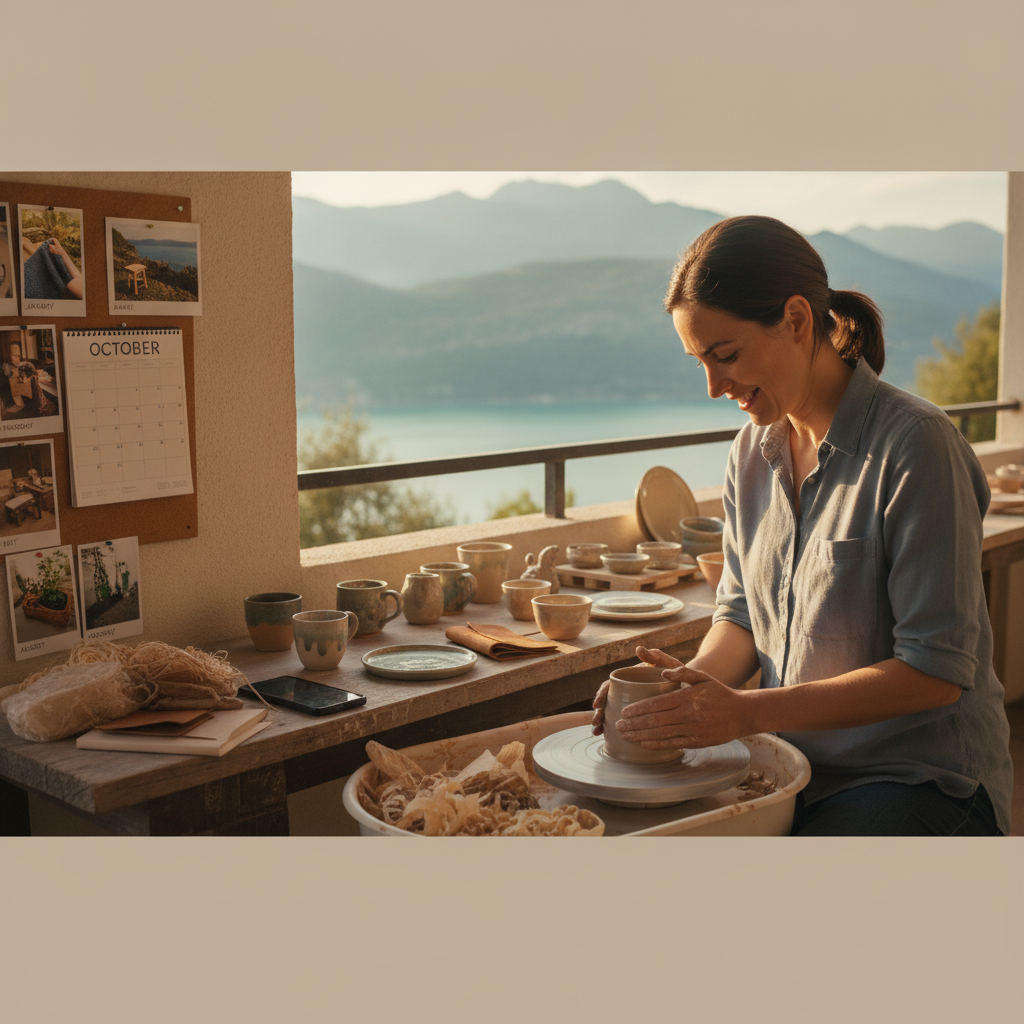
Neuroscience has long recognized that the hands and the brain are deeply intertwined — that making something physical activates reward pathways in ways that abstract achievement simply doesn't replicate. When a person planes a piece of wood flat, throws a bowl on a wheel, or binds the spine of a hand-sewn journal, the brain registers completion in a manner that corresponds to something ancient and deeply reliable. This isn't nostalgia for pre-digital life. It's recognition that a part of human cognition still expects to receive tangible evidence of effort, and grows quietly restless when that evidence never arrives.
The Particular Power of a Monthly Deliverable
Any physical hobby carries value, but choosing one that reliably produces a finished object each month adds a specific structural benefit: a rhythm of completion. Monthly feels right for several reasons. Weekly is demanding enough to become a second job; annually is so distant it fails to provide the regular reinforcement that actually rebuilds confidence. Monthly offers a cadence that's achievable alongside a full life, yet frequent enough to accumulate into something meaningful across a season. By the end of a year, a person has twelve objects — twelve moments of undeniable evidence that they made something with their own hands.
The hobbies that tend to work best in this framework are those with a clear endpoint built into their logic. Bookbinding, for instance, produces a finished journal. Leatherworking might produce a wallet or a simple bag. Wheel-thrown ceramics produce a bowl or a mug. Hand-knitting produces a hat or a pair of socks. The British craft brand Purl Soho and the ceramic supply company Axner have long oriented their product lines around exactly this kind of project-based making — and it's not accidental that their communities of users report high levels of sustained engagement, precisely because each project has a beginning, a middle, and an unmistakable end.
Why Tangibility Changes the Psychological Equation
There is something specific that happens when a person holds a finished object they made themselves. It doesn't matter whether the object is technically perfect — a slightly uneven seam, an imperfect glaze, a join that's not quite flush. The imperfections are themselves proof of human authorship. Unlike the polished outputs of software or the invisible contributions embedded in a team document, a handmade object carries the literal record of the maker's decisions, adjustments, and problem-solving. It is impossible to look at a hand-thrown mug without understanding that a person figured out how to center clay, open the base, pull the walls upward, and attach a handle without it cracking — because you are holding the evidence.
This matters beyond simple pride. When people spend extended periods in environments where their competence is invisible — where the work they do is collaborative, contextual, and difficult to separate from the contributions of others — they often lose access to a clear, personal sense of what they are capable of. A physical hobby that produces an object creates a counterweight. It is private proof, requiring no validation from a performance review or a colleague's acknowledgment. The object simply exists, and its existence means the maker was capable enough to produce it.
Choosing the Right Hobby for a Sustainable Practice
The selection of a hobby matters almost as much as the commitment to one. A practice that requires a workshop full of equipment or a commute to a specialized studio will quietly accumulate friction until it stops happening. The most sustainable options tend to be those that can be set up at a kitchen table in twenty minutes and packed away just as quickly — bookbinding, wet felting, hand-sewing leather, linocut printmaking, or small-scale weaving on a portable rigid heddle loom. Platforms like Skillshare and the online curriculum offered by the London Centre for Book Arts have made it genuinely possible to learn foundational techniques without enrolling in formal programs or committing to a physical class schedule.
For the practice to serve its deeper purpose, the hobby also needs to be honest in its demands. Attempting oil painting when a person has never held a brush before is likely to produce frustration rather than capability. Starting with a simpler skill — one where progress is visible within the first few sessions and a finished object is achievable within the first month — creates the early wins that make the practice self-sustaining. Complexity can always increase once the foundation of regular completion is established.
Building the Habit Around One Object Per Month
If you want this to work, the most important decision is not which hobby you choose but how you protect the time for it. One evening a week, treated with the same seriousness as an appointment, is enough for most monthly projects. Keep your materials accessible rather than stored in a closet — a basket on a shelf, a wooden crate near the sofa, a small kit in a drawer. When the barrier to beginning is low, the practice actually happens. When the supplies are buried, the practice becomes something you plan to do rather than something you do.
Finish each object before beginning the next. This is where the rebuild actually occurs — in the act of completion, not in the act of making. Allow yourself to photograph each finished piece and place it somewhere visible, even briefly. Twelve months from now, you will have an accumulation of evidence that no algorithm produced, no team contributed to, and no performance metric can accurately represent. It belongs entirely to you, and it will feel exactly like that.
The quiet erosion that screen-based life produces in a person's sense of capability is not dramatic enough to announce itself clearly — which is precisely what makes it so persistent. It accumulates in small increments, in the distance between effort and evidence, between working hard and holding something to show for it. A single physical hobby, practiced with consistency and oriented toward a monthly object, closes that distance in a way that is immediate, honest, and surprisingly durable. The shelf with twelve handmade objects at the end of the year isn't a monument to a hobby. It's a record of a person who remembered what their hands were for.