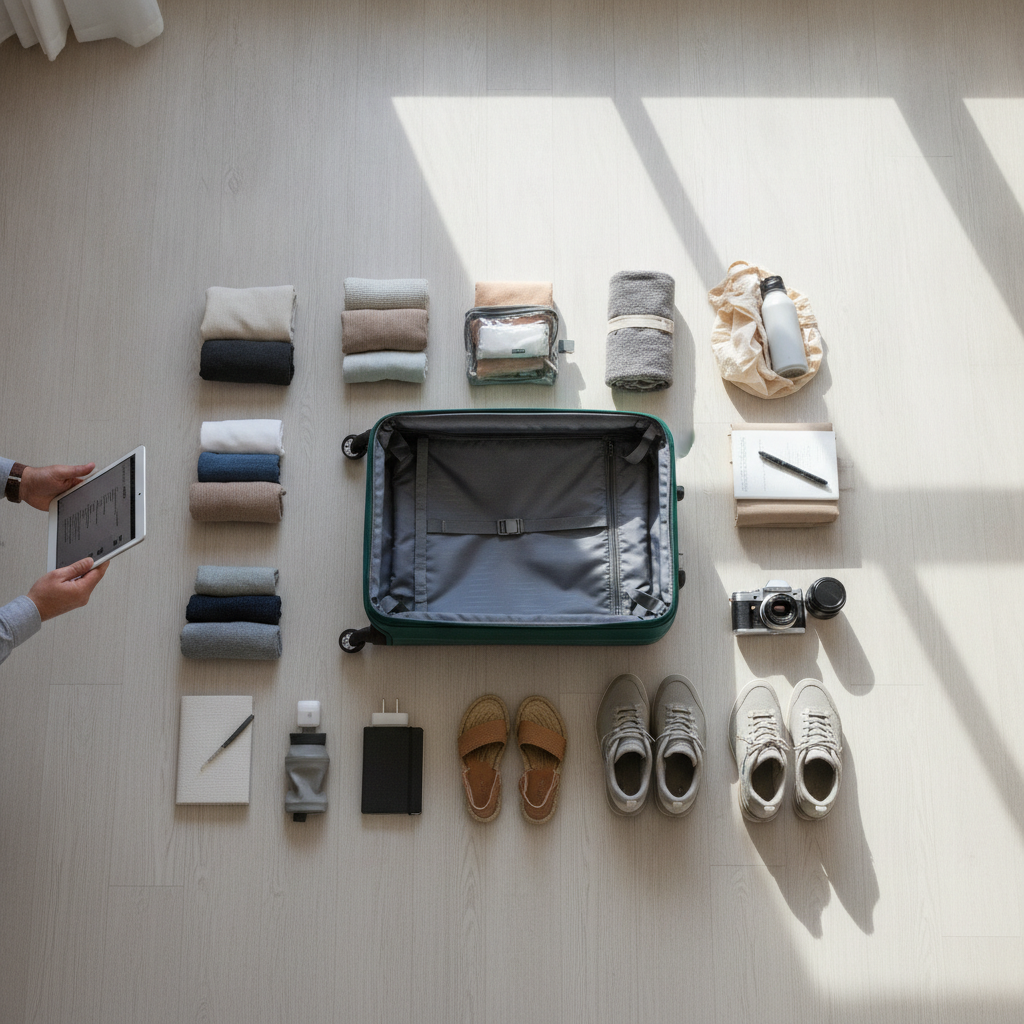
Most people approach packing the wrong way. They open the closet, start pulling things out, and then try to make it all fit — which is essentially a compression problem rather than a clarity problem. The real work of carry-on travel doesn't happen near the luggage; it happens in the mind, long before a single item touches a packing cube.
Traveling for two weeks out of a single carry-on is entirely achievable, and thousands of people do it routinely through destinations as varied as Southeast Asia and Scandinavia. But it demands a different starting point: questioning the assumptions that drive most packing decisions in the first place.
What Does "Just in Case" Actually Cost You?
The phrase "just in case" is responsible for more overpacked bags than any other habit in travel. A second pair of dress shoes, an extra jacket, three books, a full-size toiletry kit — each item feels justified on its own, but together they fill a checked bag before any essentials arrive. The cost isn't just weight; it's time spent waiting at baggage claim, energy hauling luggage through cobblestone streets in cities like Porto or Chiang Mai, and the hidden fee structures airlines quietly attach to checked bags. Traveling light isn't about deprivation — it's about recognizing that most "just in case" scenarios either never materialize or are easily solved on the road.
How Does the Capsule Wardrobe Concept Actually Apply to Travel?
The capsule wardrobe approach, long popular in everyday fashion, translates remarkably well to long-trip packing. The principle is simple: choose a small set of versatile, neutral-toned pieces that work together in multiple combinations rather than building a separate outfit for each day. A merino wool base layer from a brand like Icebreaker, for instance, can function as a light sweater, a mid-layer under a rain jacket, or a comfortable piece for a long-haul flight. Dark trousers that pass as casual or smart depending on footwear cover far more ground than two separate pairs. The goal is that every item in the bag earns its place by serving at least three distinct purposes.
This isn't a new concept, but most travelers apply it inconsistently — selecting a few versatile pieces and then adding extras "just to be safe," which undoes the discipline entirely.
Why Do Toiletries Take Up More Space Than They Should?
Toiletries are among the most predictable sources of carry-on overflow, and also among the most avoidable. Solid shampoo bars, concentrated soap tablets, and dual-purpose products — such as a moisturizer with SPF — can cut the toiletry footprint dramatically without sacrificing comfort. Brands like Lush and Ethique have made solid-format personal care products both accessible and genuinely effective for travel use. Most hotels, guesthouses, and Airbnb-style accommodations provide the basics, and pharmacies in nearly every destination stock what they don't. The mental shift required is accepting that restocking on the road is normal, not inconvenient — and that full-size bottles carried from home rarely get fully used anyway.
How Should You Decide What Stays Home?
A useful exercise before packing involves asking a single question about each item: would you carry this object three miles on foot through an airport, up four flights of stairs in a guesthouse, and onto a crowded metro without frustration? If the honest answer is no, it probably shouldn't come. This isn't a rhetorical test — it reflects the genuine physical reality of carry-on travel through places where elevators and baggage trolleys are not guaranteed. The exercise has a clarifying effect, separating items that seem necessary at home from those that will actually earn their weight on the ground.
Another approach used by experienced light packers is laying out every intended item and then removing a third of it before repacking. The result is almost always a bag that still contains everything genuinely needed.
What Role Does the Right Bag Actually Play?
The carry-on itself matters more than many travelers realize — not as a status object but as a functional constraint. A bag that expands, has too many pockets, or runs right up to the maximum airline dimension tends to encourage overpacking. A structured, slightly smaller bag like the Osprey Farpoint 40 or a comparable travel pack with a front-loading main compartment creates natural limits and organizes contents in a way that reduces retrieval time at security. Packing cubes — particularly compression versions — help segment clothing by category and maintain organization across two weeks without requiring a full unpack at every stop. The bag shapes the behavior; choosing it thoughtfully shapes the whole trip.
How Do You Make This Work in Practice?
Once the mental shift has happened, the practical steps are straightforward. Start by listing every category of item you think you'll need, then cut each category to its minimum viable version. For clothing, plan around seven to nine total pieces — not outfits — that mix and match freely. Pack one pair of shoes you can walk in all day, and if a dressier occasion seems genuinely likely, choose a second pair that collapses flat. Use your personal item allowance (a daypack or tote) for electronics, a book, snacks, and anything you'll need inflight. Keep liquids to a single quart bag and challenge yourself to fill only half of it. Before closing the bag, hold each remaining item and ask whether you'd carry it the full distance of the trip. If the answer wavers, leave it.
The first time you walk off a plane in a new city with only what's on your back — no waiting, no dragging, no fees — the calculus changes permanently. Carry-on travel isn't about what you give up. It's about what you stop spending energy on, so that the trip itself can take up more room.