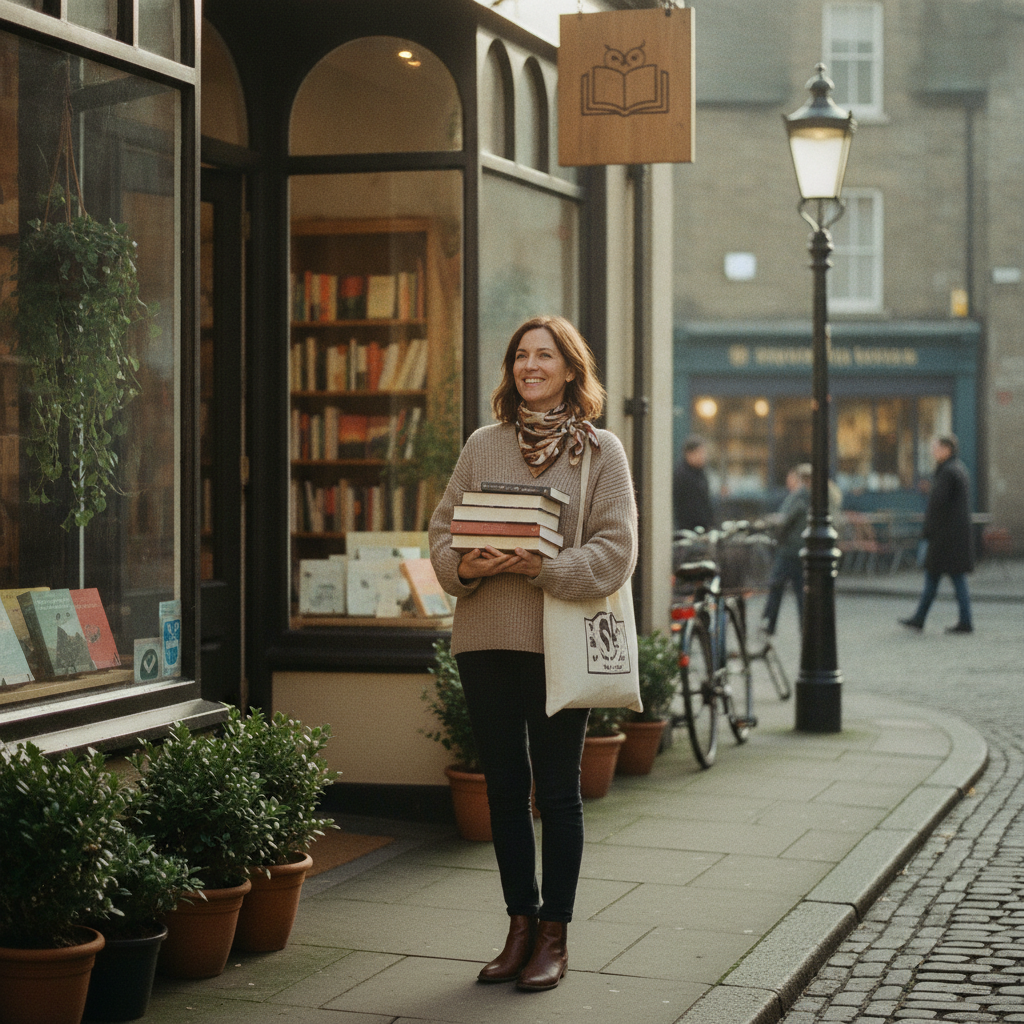
There is a particular kind of stillness that settles over a person the moment they step into a small, independently owned bookshop on a quiet Saturday morning. The light tends to fall differently in these places — through old glass, past hand-lettered signs, across shelves that somebody arranged with genuine conviction rather than sales data. Nothing about the experience is optimized. That is precisely why it works.
Reading algorithms have become remarkably sophisticated. Platforms like Goodreads, Amazon, and Spotify-style book subscription services can map a reader's preferences with impressive accuracy, surfacing titles that align with past choices, trending genres, and demographic patterns. The recommendations are often good. But good and *enriching* are not always the same thing. An algorithm reflects who you already are. A carefully tended independent bookshop — the kind you find on a side street in Portland's Alberta Arts District, or tucked between a bakery and a tailor in Edinburgh's Stockbridge neighborhood — has a way of suggesting who you might become.
The Accidental Discovery That Algorithms Cannot Manufacture
The central limitation of any recommendation engine is that it can only work from what it already knows about you. It feeds on your history, which means it tends to deepen existing grooves rather than carve new ones. A reader who has spent two years absorbed in Scandinavian crime fiction will keep receiving suggestions for Scandinavian crime fiction — and will be subtly steered away from the Argentinian short story collection sitting three feet away that might have cracked something open entirely. Independent bookshops operate on a different logic entirely. The staff recommendations taped to shelves, the idiosyncratic front-table displays, the fact that one shop in a mid-sized city might stock an entire wall of translated poetry while another focuses almost entirely on natural history — these choices reflect human curation at its most personal, and encountering them produces the particular pleasure known in Japanese as *serendipity no ma*, a phrase that roughly captures the meaningful gap opened by unexpected encounter. Walking into a shop you've never visited before, with no list in hand, is one of the last remaining environments in daily life where genuine surprise about your own interests is still possible.
What Monthly Repetition Actually Does to the Inner Life
A single visit to an unfamiliar bookshop is pleasant. A monthly habit of visiting different ones — spread across a city, or across a region, or deliberately sought out while traveling — does something more structural. Over the course of a year, a person who does this builds a quietly expanding map of human thought and culture that no single platform could assemble for them. They begin to notice patterns across shops: which neighborhoods tend toward literary fiction, which toward practical craft, which keep unexpected philosophy sections. They develop opinions about curation itself, which is a form of aesthetic education. They start to understand their own reading as something with a *shape*, a word borrowed from the French *forme intérieure* — interior form — used by literary scholars to describe the organizing sensibility a reader gradually develops through sustained, varied exposure to books as physical objects in particular places. This is not the same as reading more books. It is reading differently, with more of the self engaged.
The rhythm matters as much as the act. Once a month is frequent enough to build continuity — you remember the last shop you visited, the book you almost bought, the conversation you overheard — but rare enough that each visit retains the quality of occasion. It does not become routine in the deadening sense. It becomes *ritual*, which is routine invested with intention and meaning.
Bookshops as Places That Teach You to Be Present
There is growing awareness, across fields concerned with human attention and wellbeing, that environments shape cognition in ways people rarely notice. A bookshop — particularly an independent one with no café attached, no events calendar being promoted over a loudspeaker, no loyalty app pinging for attention — is one of the few commercial spaces left that seems designed, however accidentally, to slow a person down. The physical act of reading spines, pulling a book from a shelf, reading the first page while standing, then replacing it and moving on is a form of unhurried attention that has become genuinely unusual. Powell's Books in Portland or Daunt Books in London understand this implicitly; neither shop makes any apology for the fact that a visitor might spend two hours there and leave with nothing, or with a single slim volume of essays they could not have named when they walked in. That experience of open, unfocused attention — what the psychologist Mihaly Csikszentmihalyi called *flow* in a different but related context — is something algorithms are structurally unable to offer, because algorithms require a destination, and the deepest discoveries happen when there isn't one.
Building the Habit Without Overthinking It
For anyone who wants to try this, the mechanics are genuinely simple. Pick one Saturday or Sunday morning each month — the same weekend, if that helps with consistency, or a flexible one if spontaneity suits better. Choose a different independent bookshop each time. Go alone, or with someone who agrees not to hurry. Leave a phone in a pocket rather than holding it. Spend however long feels natural — forty minutes or two hours, it doesn't matter. Buy something only if something genuinely calls out, and resist the pull to photograph the shelves for social media before you've actually experienced the shop. A small notebook for jotting titles, impressions, or the name of the neighborhood is more useful than any app.
Over time, you might begin to notice that the books you're drawn to in these shops don't always match what an algorithm would have predicted. You might find yourself buying a book on ceramics, or on the history of cartography, or a novel from a country you've never visited and hadn't thought to visit. These small, unplanned expansions accumulate. They do not transform a person overnight, but they do, gradually and reliably, make that person more interesting to themselves — which is, perhaps, the most honest definition of a richer inner life.
That stillness you feel stepping through the door on a quiet Saturday morning is not just atmosphere. It is the feeling of a mind that has stopped being managed and started, once again, to wander — and wandering, as any well-stocked independent bookshop seems to wordlessly argue, is where the best things tend to be found.