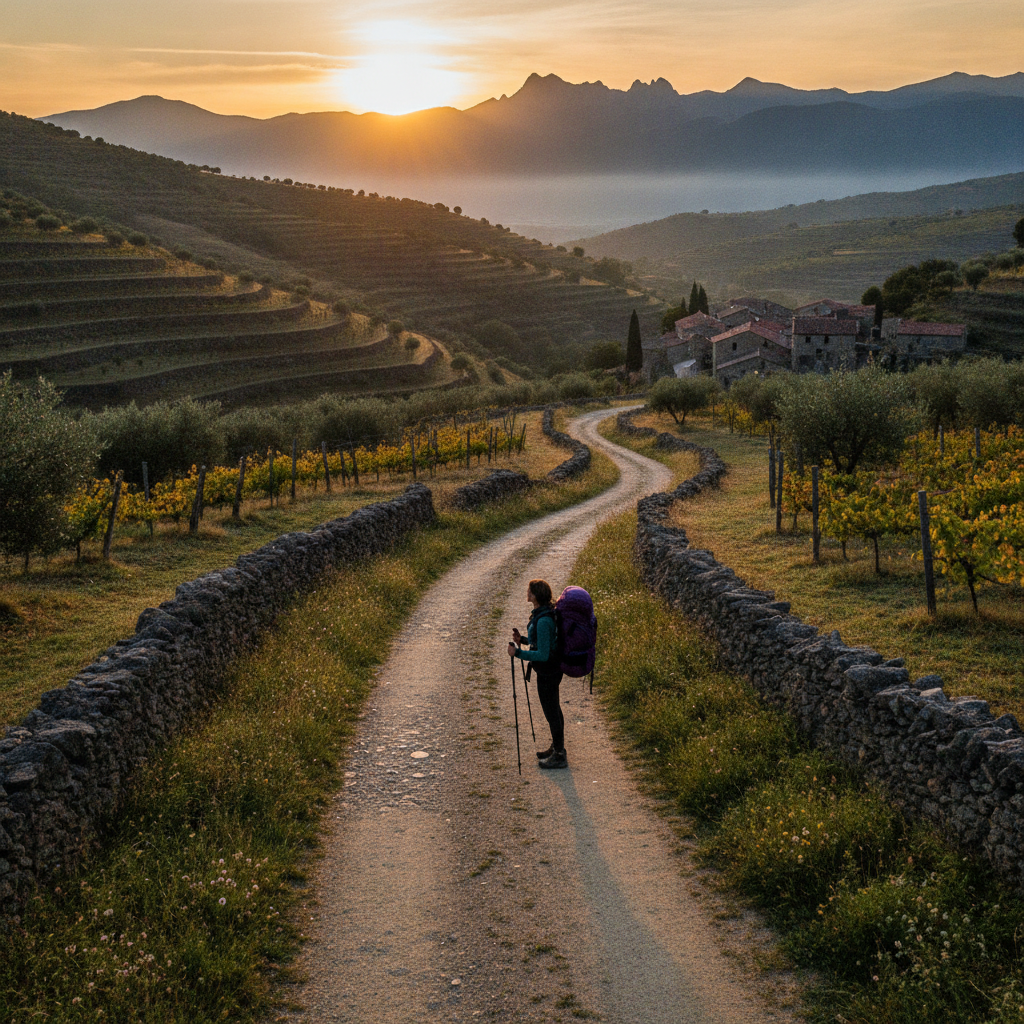
A country looks entirely different at three miles per hour. When a traveler structures a trip around a long-distance walking route rather than a conventional circuit of cities and attractions, the journey reorganizes itself around terrain, weather, and the accumulated logic of a path that has been walked by others for generations. The country stops being a collection of highlights and becomes something more continuous — a living geography with its own internal rhythm, its own transitions between one kind of life and another.
What the Path Already Knows
Long-distance routes are rarely arbitrary. Trails like the Camino Francés across northern Spain, the GR20 through Corsica, or the Lycian Way along Turkey's southwestern coast follow corridors that predate modern tourism by centuries. They trace pilgrimage roads, shepherd migrations, trade connections between inland villages and coastal ports. Walking them is, in a sense, inheriting a line of movement that the landscape itself shaped over time. The hills are where the path climbs not because a route designer wanted a challenge, but because that was always the way through. The villages appear at intervals that reflect how far a loaded mule could walk before nightfall. The geography teaches its own history in a way no museum exhibit quite manages to replicate.
When a traveler commits to a route rather than a highlight reel, the country also becomes scalar in a way that changes comprehension. The distance from one region's character to another registers in the body. Walking from the meseta's open plateau into the wine country of La Rioja, the shift in light, soil color, and architecture happens so gradually that the traveler experiences it as a slow continuous argument rather than a sudden contrast. This is how the country actually transitions — not at a border sign, but through ten kilometers of gradual change in what grows and how houses are built.
The Villages That Never Make the Guidebook
Conventional itineraries concentrate travelers in places that have already been selected for them — the well-photographed old towns, the famous viewpoints, the UNESCO-listed centers. Long-distance walking routes, by contrast, pass through places that exist for entirely other reasons. A hamlet on the Via Francigena through Tuscany may have a single bar, a small church, and a noticeboard covered in handwritten announcements. It wasn't built to receive visitors; it was built because people needed to live there. Stopping for coffee in such a place, or asking the woman behind the counter which path continues south, produces a different kind of exchange than anything that happens inside a tourist infrastructure. The village doesn't perform itself. It simply is itself, and the walker is a temporary presence passing through a place that has its own concerns entirely unrelated to being visited.
This is where a walking itinerary changes what the country reveals. The places in between — the ones the train passes through without stopping, the ones the highway bypasses entirely — are often where the most specific and unrepeatable texture of daily life still exists. A roadside shrine maintained with fresh flowers in rural Portugal tells a story about devotion and community that no guided tour explains. A hand-painted sign advertising eggs or honey on a lane in rural Slovenia implies an entire economy of small holdings that has nothing to do with the country's brochure identity.
Hospitality at Its Most Unornamented
Walkers on long-distance routes tend to encounter a particular form of hospitality that rarely appears in the world of hotels and restaurant reservations. In many walking cultures, there is an understood obligation toward the pilgrim or the traveler on foot — a tradition so old it has its own vocabulary. In Spain, the phrase *buen camino* — wishing someone a good path — is offered freely to anyone with a backpack and worn boots, by locals who may have said it to hundreds of walkers without once setting foot on the route themselves. In parts of rural Georgia, the concept of *mghmerte moadile*, a traveler blessed by God, carries a residual weight that shapes how strangers are received, even in secular times. These social textures don't surface in the cities. They live along the paths.
Accommodation along walking routes also tends to operate on different social terms. A refugio in the Pyrenees, an albergue in rural Andalusia, or a pilgrim hostel outside Sintra creates conditions in which strangers share tables and compare blisters and exchange information about what lies ahead. The conversation is immediate and practical in a way that hotel common rooms rarely produce. Walkers tend to know something useful — where the next water source is, which village café opens early, whether the forecast holds. This shared practical intelligence creates a temporary community with its own internal generosity.
How Slowness Restructures Understanding
There is a cognitive dimension to walking a country that faster modes of travel don't produce. When you arrive somewhere on foot after four hours of uphill, the place has been earned in a way that changes how it registers. The church in the valley isn't just a church — it's the landmark you navigated toward for three kilometers through cloud, the first sign of shelter after a long exposed ridge. The meaning isn't imposed by a guidebook's star rating; it accumulates through the walk itself. This is what slow travel advocates have always argued, but the long-distance walking route makes the argument structurally inescapable. You cannot rush a path. The path has its own pace, and the country reveals itself only as fast as your legs allow.
For those considering this approach for the first time, a few practical orientations help. Routes like the Fishermen's Trail in Portugal or the Pennine Way in northern England offer well-marked paths with accessible infrastructure. Apps like Komoot provide offline mapping that works without data coverage in remote areas. Starting with a five-day segment rather than a complete multi-week crossing allows a traveler to test the mode before committing fully. The only essential shift is conceptual: releasing the itinerary built around places and accepting instead one built around movement.
A country seen on foot gives back something that speed consistently withholds. The broad declarative observation that travel begins this way — that everything looks different at three miles per hour — turns out to be less a statement about pace than about attention. The long-distance walking route teaches a traveler to receive what is actually there rather than what was expected, and in that exchange, a country becomes something more than its destinations. It becomes the whole of what lies between them.