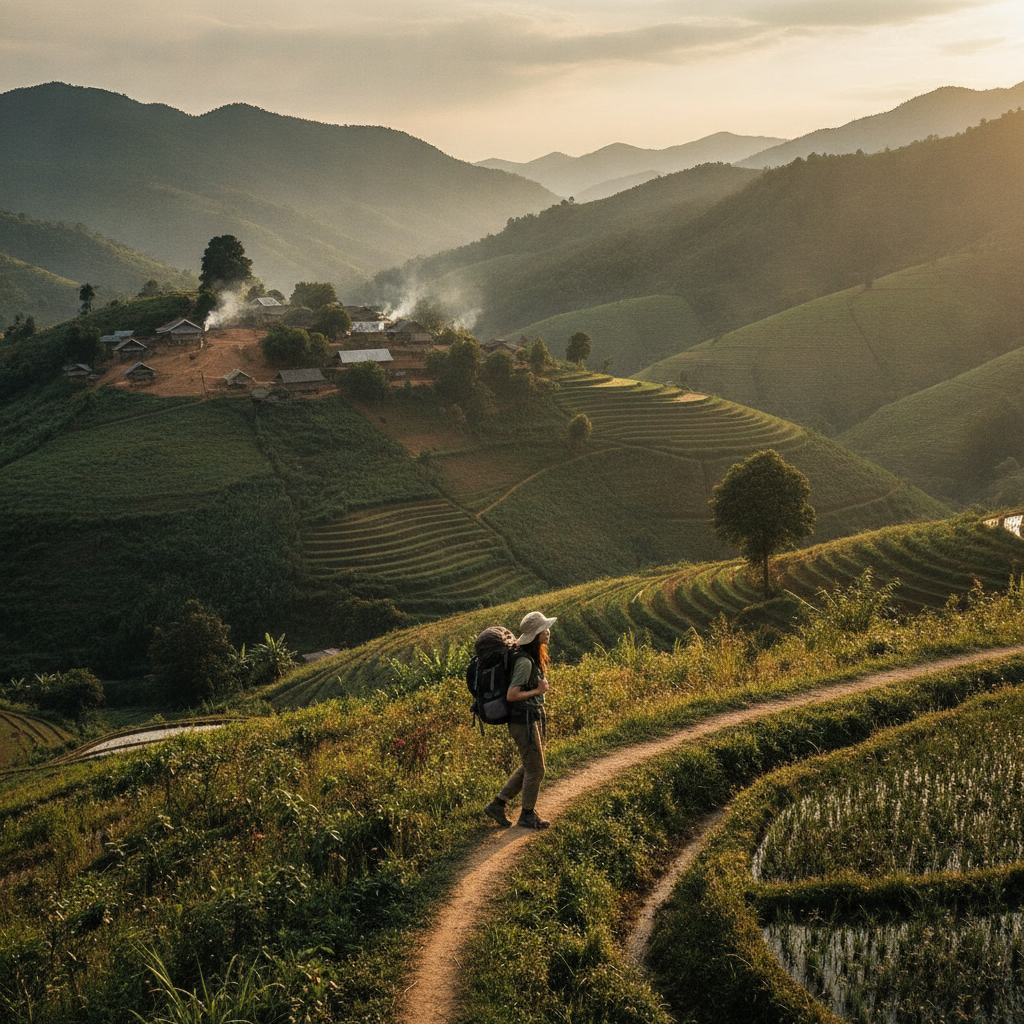
There is a particular quality of silence that settles over a traveler the moment the familiar circuit drops away. In northern Laos, that moment arrives somewhere on a winding mountain road between Nong Khiaw and Muang Ngoi, when the last guesthouse with an English menu disappears in the rearview and the valley opens into something that hasn't been arranged for anyone's convenience. Most visitors who come to Laos move predictably through Luang Prabang — temple to waterfall to cooking class — and leave believing they've understood something about the country. The ones who push further north discover that Luang Prabang, beautiful as it is, was only the threshold.
The Geography That Shapes Everything
Northern Laos above the Nam Ou River is not built for hurrying. The Phongsali Province alone — the country's northernmost region, bordering both China and Vietnam — contains ethnic minority communities whose traditions predate any modern border drawn around them. Villages here belong to the Akha, Phunoi, and Lue peoples, each with distinct weaving patterns, agricultural rhythms, and ceremonial calendars. The terrain enforces a kind of patience: roads switchback through limestone karst formations and dense forest, river routes operate on seasonal schedules, and the notion of arriving exactly when planned quietly dissolves. Travelers who resist this tend to have a miserable time. Those who accept it find that geography becomes its own form of guidance.
The town of Muang Khua, sitting at the confluence of the Nam Ou and Nam Phak rivers, is a useful example of what this region offers to the unhurried. It has no grand temple complex, no infinity pool overlooking a UNESCO-listed skyline. What it has is a morning market — the talat sao — where Akha women arrive before dawn carrying foraged greens and dried river fish, where transactions happen in three languages simultaneously, and where a traveler willing to simply stand and observe will learn more about daily life in an hour than a week of organized tours might deliver. The talat sao is not curated. It exists for locals, and the traveler's presence in it is a privilege, not a service.
Moving Between Towns Without a Fixed Plan
The slow boat system along the Nam Ou was once the primary artery connecting villages that roads couldn't reach. In certain stretches it still is, though hydroelectric dam construction over the past decade has altered water levels in ways that affect navigability depending on the season. Travelers making their way from Nong Khiaw toward Phongsali typically piece together a route using a combination of river transport, shared songthaew — covered pickup trucks that function as communal taxis — and the occasional overnight bus. This patchwork quality is not a flaw in the infrastructure; it's an accurate reflection of how people in these communities have always moved between places, adapting to whatever the river or the road allows on a given day.
What surprises most travelers is how manageable this feels once the anxiety of fixed itineraries loosens. Guesthouses in Muang Ngoi Neua, a village accessible only by boat and therefore genuinely car-free, post handwritten boards in common areas listing the next day's expected departures. These boards update themselves, erased and rewritten in chalk when a boat doesn't show, replaced with new departure times scratched in by the guesthouse owner after a conversation with the boatman. There's an informal intelligence network operating across these small towns that functions better than any app, built entirely on relationships and spoken word.
What Culture Actually Feels Like at This Distance
The baci ceremony — a Lao blessing ritual in which white cotton strings called sai sin are tied around the wrists of guests or community members to call wandering spirits back to the body — occasionally includes travelers who have spent enough time in a village to be considered guests in a meaningful sense. This is not something that happens on a schedule or appears in a tour brochure. It emerges from accumulated trust: eating where locals eat, greeting in Lao rather than expecting English, showing up at the morning market more than once. The sai sin strings, once tied, are traditionally worn for three days. Removing them early is considered bad luck, but more than superstition, it would signal a kind of impatience that the culture reads clearly.
Traveling through these hill towns asks something of a person that comfort-oriented travel doesn't. It asks for a tolerance of ambiguity — not knowing what the dish contains, not understanding the conversation happening at the next table, not being certain whether the path leads to the waterfall or away from it. This ambiguity, encountered honestly rather than engineered away, produces a particular kind of awareness. The traveler becomes more observant simply because observation is all they have. Language fails, Wi-Fi drops, the map shows a road that may or may not exist. What remains is presence.
Finding Your Own Rhythm in the North
If you make it as far as Phongsali town, sitting at nearly 1,500 meters elevation in a region where old Chinese-style shop houses line the main street and Yunnan pu-erh tea is sold in pressed cakes from dark wooden stalls, you will almost certainly be one of very few foreign travelers in sight. The town has a quiet industry of its own, oriented almost entirely toward trade with China rather than toward tourism. The tea plantations surrounding it include some of the oldest cultivated tea trees in the world, their gnarled trunks wrapped in moss, their leaves harvested by Akha farmers who have been doing exactly this for generations. Walking through one of these gardens with a local guide — not a packaged tour, but someone arranged through your guesthouse who has tea farmers in their family — is the kind of encounter that recalibrates everything you thought you knew about what it means to taste something with history in it.
This is what northern Laos offers when you leave the comfortable circuit behind: not novelty for its own sake, not the thrill of difficulty, but the steady, accumulating experience of a place that hasn't been simplified for your arrival. The silence on that mountain road was not emptiness. It was the beginning of something that takes a little time to learn how to hear.