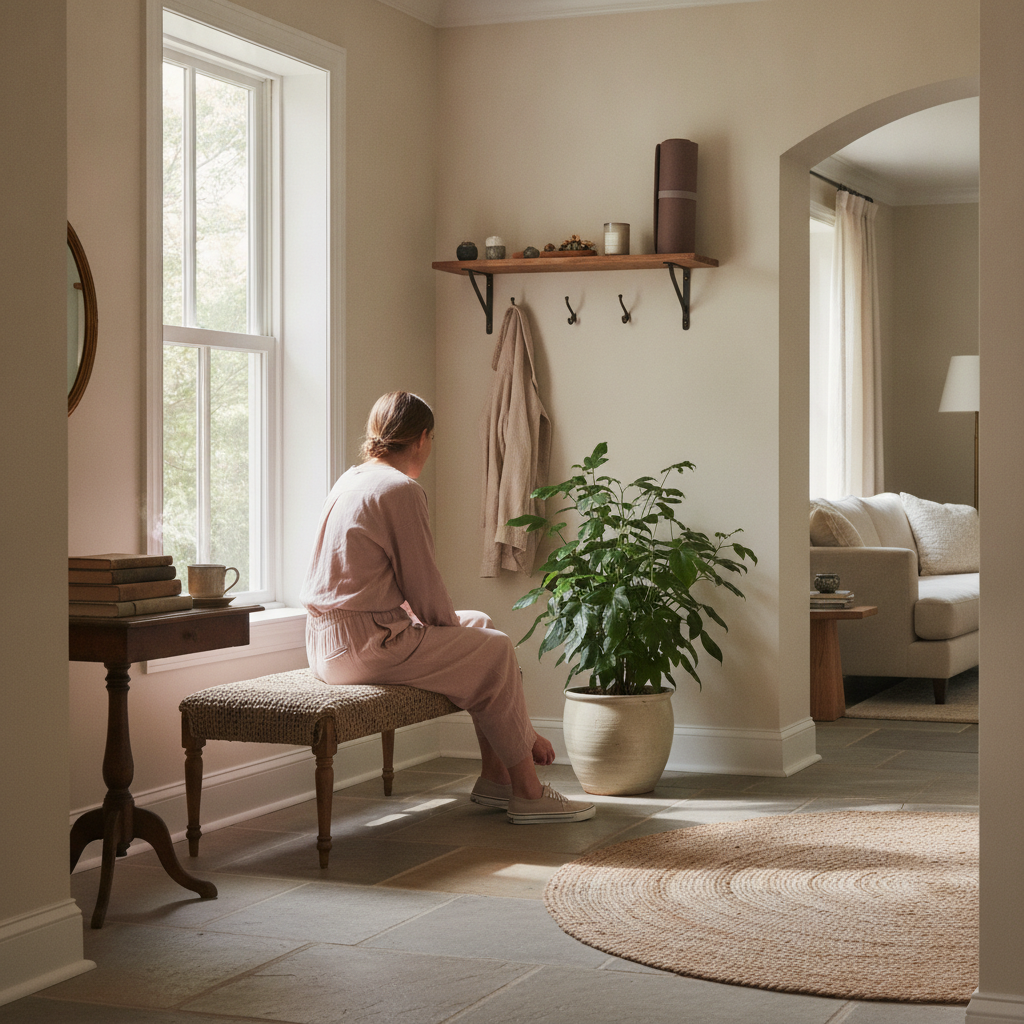
The moment between outside and inside is one of the most underestimated transitions in daily life. A person crosses a threshold dozens of times each week, shedding one context and stepping into another, yet most entrances are treated as pure logistics — a place to drop keys, kick off shoes, and keep moving. That hurried passage costs something. The unprocessed energy of commutes, errands, and obligations follows a person right through the door and settles into the home like an uninvited guest, often lingering long after the day should have ended.
The Threshold as a Psychological Boundary
In architecture and anthropology, the threshold has long been recognized as more than a structural element. Ancient Roman culture observed the *limen* — the liminal space between two defined states — as a zone requiring its own acknowledgment. This concept survives in the word "liminal" itself, referring to transitional states that belong fully to neither the world behind nor the world ahead. A home entrance, understood this way, is not merely a hallway or a foyer; it is a psychological seam. How a person moves through it, or whether they move through it consciously at all, shapes the emotional register they carry into their most personal space.
Why the Body Carries What the Mind Hasn't Processed
The nervous system does not automatically reset when a person walks through a door. Stress responses, mild irritability, and the background hum of unfinished mental tasks tend to persist well past the situation that triggered them. This is sometimes called *psychological spillover*, a well-documented tendency for the emotional residue of one context to bleed into the next. Families in neighborhoods like Park Slope in Brooklyn or Peckham in South London report that the quality of evening time shifts noticeably depending on how family members arrive home — whether they enter abruptly or take even a brief moment to decompress at the entrance before engaging with household life.
The Physical Setup of a Decompression Zone
Creating a deliberate decompression zone doesn't require renovation or significant expense. The goal is to design a small area — even a corner of an entryway — that invites a brief, conscious pause. A hook for a coat, a seat low enough to remove shoes without rushing, a small surface for personal items, and perhaps a single plant or object that draws the eye gently are sufficient. Japanese interior philosophy, particularly the concept of *genkan* — the lowered entry area traditional to Japanese homes where outdoor shoes are removed — treats the entrance as a formal transition space, one that physically enacts the separation between public and private life. Borrowing that intention, even without the architecture, carries real effect.
Rituals That Anchor the Transition
A decompression zone gains its power not just from its physical arrangement but from the small rituals performed within it. Removing shoes is one; it signals the body that a shift is underway. A brief breath — two or three slow exhales — takes less than thirty seconds and actively interrupts the stress cycle. Some people place a small notebook at the entrance to write a single word or phrase representing what they're leaving behind, a practice loosely inspired by *haiku*-style brevity that Japanese poets used to capture transitions in nature. Apps like Calm or Headspace offer short one-to-three-minute guided arrivals designed for exactly this kind of moment, and using one consistently builds the associative cue over time.
How Children and Shared Households Benefit
The logic of the decompression entrance applies with particular force in households with children or multiple adults sharing space. When one person arrives carrying unprocessed tension and immediately encounters demands, conversation, or conflict, the emotional contagion spreads quickly. A household that builds even a loose norm around arrival — a few minutes of quiet before engaging, a brief check-in ritual, a shared understanding that the entrance is a transition space rather than a launching pad — creates a buffer that benefits everyone. Child development researchers have long noted that the emotional tone set in the first minutes after a parent arrives home has an outsized influence on a child's sense of security for the remainder of the evening.
Scent, Light, and Sensory Cues That Reinforce the Shift
The sensory environment of an entrance works on the nervous system below the level of conscious decision-making. Scent is particularly powerful because olfactory signals travel directly to the brain's limbic system, which governs emotion and memory. A diffuser with lavender or cedarwood near an entrance, or a candle lit upon arrival, creates an immediate sensory cue that the body begins to associate with settling. Lighting matters too — harsh overhead lights maintain alertness, while warmer, lower light encourages the physiological shift toward rest. Brands like Aesop and Muji have built product lines partly around this understanding, offering entrance-oriented scents and minimalist accessories designed to support exactly this kind of sensory choreography.
Making the Practice Your Own
Once you understand that the entrance is a zone of genuine psychological leverage, you can begin to shape it according to what your particular nervous system responds to. Try spending one week paying close attention to how you feel within twenty minutes of arriving home, and then compare that to how you feel on days when you pause at the threshold — even briefly — versus days when you rush straight through. You may find that a single object, a specific scent, or a thirty-second breath practice makes an unmistakable difference. The entrance doesn't need to become a ceremony; it needs only to become intentional. That small shift in awareness, practiced consistently, tends to ripple through the entire evening in ways that feel quietly surprising.
There is something worth reclaiming in the moment between outside and inside — the pause that most people rush past without a second thought. A home entrance treated as a decompression zone returns a person to themselves before the evening begins, rather than waiting for exhaustion or conflict to force that return much later. The threshold that was once a blur becomes a quiet reset, a place where the day's weight is acknowledged, set down, and left at the door — exactly where it belongs.