There's a particular kind of freedom that comes from arriving at a small Greek port with no fixed plan for tomorrow. The Ionian Islands — Corfu, Lefkada, Kefalonia, Ithaca, Zakynthos, and their quieter neighbors — are linked by a network of ferries that rewards travelers who stay loose and follow the weather, the mood, and the occasional recommendation from someone they met over coffee. Pre-booking every stop sounds sensible, but it often works against you here. The region moves at its own pace, and the best version of an Ionian trip tends to emerge rather than get scheduled.
Understand How the Ferry Network Actually Works
The Ionian ferry system isn't one unified service — it's a patchwork of regional operators running routes between specific island pairs. Ionian Ferries and Levante Ferries cover many of the central connections, while shorter crossings like the one between Nidri on Lefkada and Frikes on Ithaca run almost like bus services. Frequencies increase significantly from May through September, which means missed boats rarely strand you for long. Understanding this structure before you leave home helps you think of ferries as a flexible grid rather than a fixed timetable, which is exactly the mindset that makes self-guided island hopping work.
Book Your First Night Only, Then Reassess
Arriving with at least one confirmed accommodation gives you a landing pad without locking in the rest of the trip. Choose a central island like Kefalonia or Corfu as your entry point, secure accommodation for the first two nights, and treat everything after that as open. Once you're on the ground, you'll quickly absorb how long you want to stay, which neighboring island keeps coming up in conversation, and where the crowds seem to be heading. Platforms like Booking.com and local guesthouses often have same-day or next-day availability outside of peak August weeks, so the risk of being stuck without a room is lower than most travelers expect.
Read the Ferry Boards Before Making Decisions
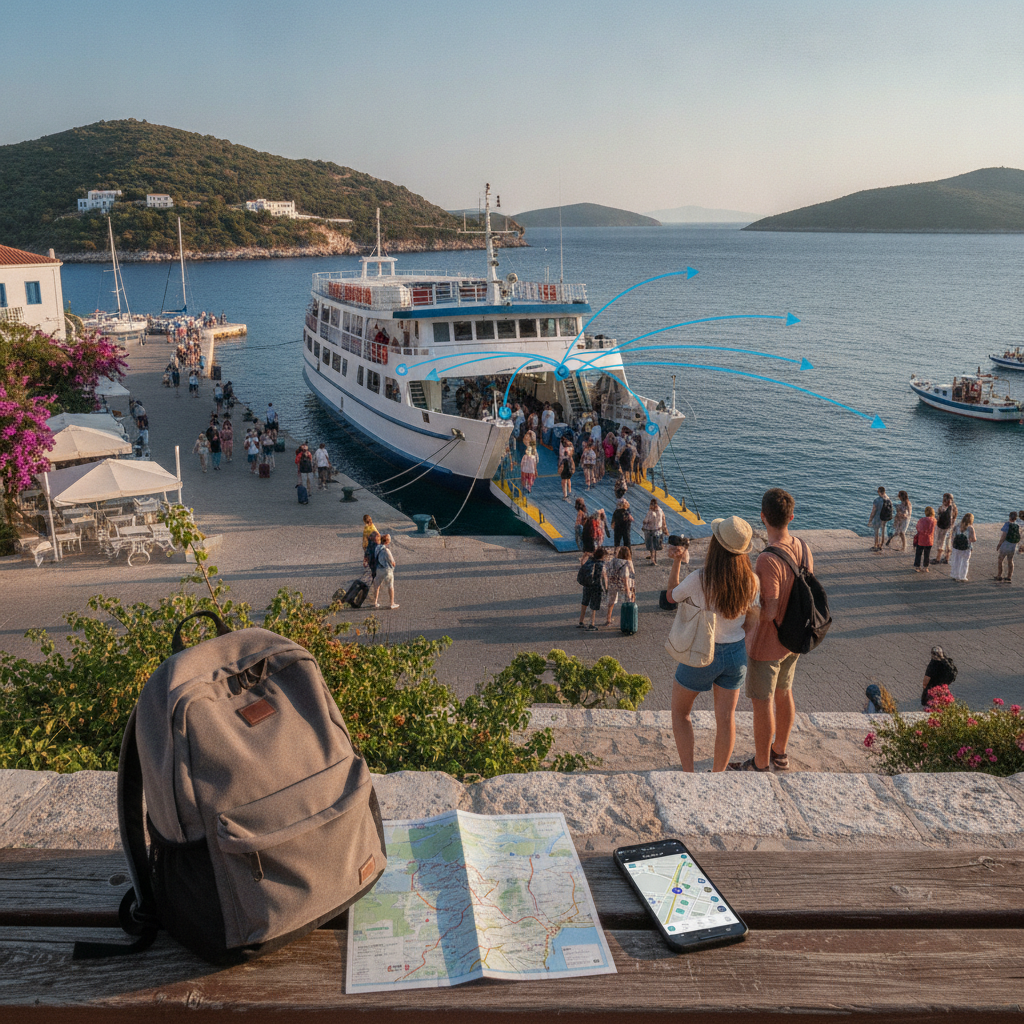
Every port town in the Ionians has a physical ferry schedule posted near the dock, and most ticket agents — small booths run by individual operators — can tell you which crossings run tomorrow and roughly how full they've been running. This is more useful than any app. The information is fresh, local, and specific to actual conditions. Spend fifteen minutes at the port the afternoon before you plan to move on, and you'll have a clear picture of your options. In high season, some popular routes like Argostoli to Zakynthos fill up faster for vehicle crossings, but foot passengers almost always find space.
Keep Your Luggage Light Enough to Be Spontaneous
This is the practical constraint that makes everything else possible. A heavy rolling suitcase doesn't belong on a self-guided ferry trip — not because ferries won't take it, but because it shapes every decision around logistics rather than opportunity. A well-packed carry-on sized bag or a 40-liter backpack means you can walk off a ferry, decide to explore the port town for another day, and change your plans without consequence. Packing light isn't about minimalism for its own sake; on a trip like this, it's the tool that keeps the itinerary genuinely flexible.
Use Ithaca as a Reset Point Between Busier Islands
Ithaca sits in the middle of the Ionian chain and remains one of the least commercialized islands in the group. It connects to Kefalonia, Lefkada, and the mainland port of Patras, making it a natural junction rather than a detour. More importantly, it slows everything down. The main town of Vathy is small, beautiful, and easy — good tavernas, a harbor, and very little pressure to do anything in particular. Spending two or three unplanned nights on Ithaca between more active stops is a reliable way to avoid the fatigue that creeps into back-to-back ferry itineraries. Think of it less as a destination and more as a pause.
Track Weather Patterns, Not Just Forecasts
The Ionian Sea can be choppy, especially on the southern routes toward Zakynthos, and some smaller ferries suspend service in rough conditions. Rather than checking a single day's forecast and committing, watch the general pattern over three or four days. Apps like Windy give a useful visual read on sea conditions, and locals tend to know from experience when a settled spell is coming. If you've got a crossing in mind and the weather looks uncertain, waiting a day in a comfortable place is almost never the wrong call. The islands reward patience in a way that tightly scheduled trips never allow.
Budget for Flexibility, Not Just Fixed Costs
Ferry tickets between Ionian islands are genuinely affordable — most crossings cost somewhere in the range of a decent restaurant meal — so the financial case for keeping your itinerary open is straightforward. The bigger budget consideration is building in a cushion for extra nights, unexpected meals in places you want to linger, and the occasional taxi between a port and a village not served by buses. Travelers who budget only for their confirmed stops often find themselves cutting the trip short when an unplanned opportunity appears. A modest daily buffer keeps the trip from becoming a series of financial calculations every time a good option surfaces.
Embrace the Ports Themselves as Part of the Experience
Fiskardo on Kefalonia, Gaios on Paxos, and Vasiliki on Lefkada are ferry ports, but they're also genuinely lovely places to spend time — not just pass through. The instinct on a multi-island trip is to treat each crossing as a transition, but some of the most memorable hours come from sitting at a port café watching boats come and go, with no particular schedule and no real urgency to move on. Letting the ferry port be a destination rather than a waypoint shifts the whole rhythm of the trip.
The Ionian Islands continue to attract travelers looking for something slower and more textured than a resort week, and the ferry infrastructure that connects them keeps improving in reliability without losing its informal character. Anyone willing to hold plans loosely and trust the network will find that the itinerary writes itself — one crossing, one harbor, one unexpected afternoon at a time.