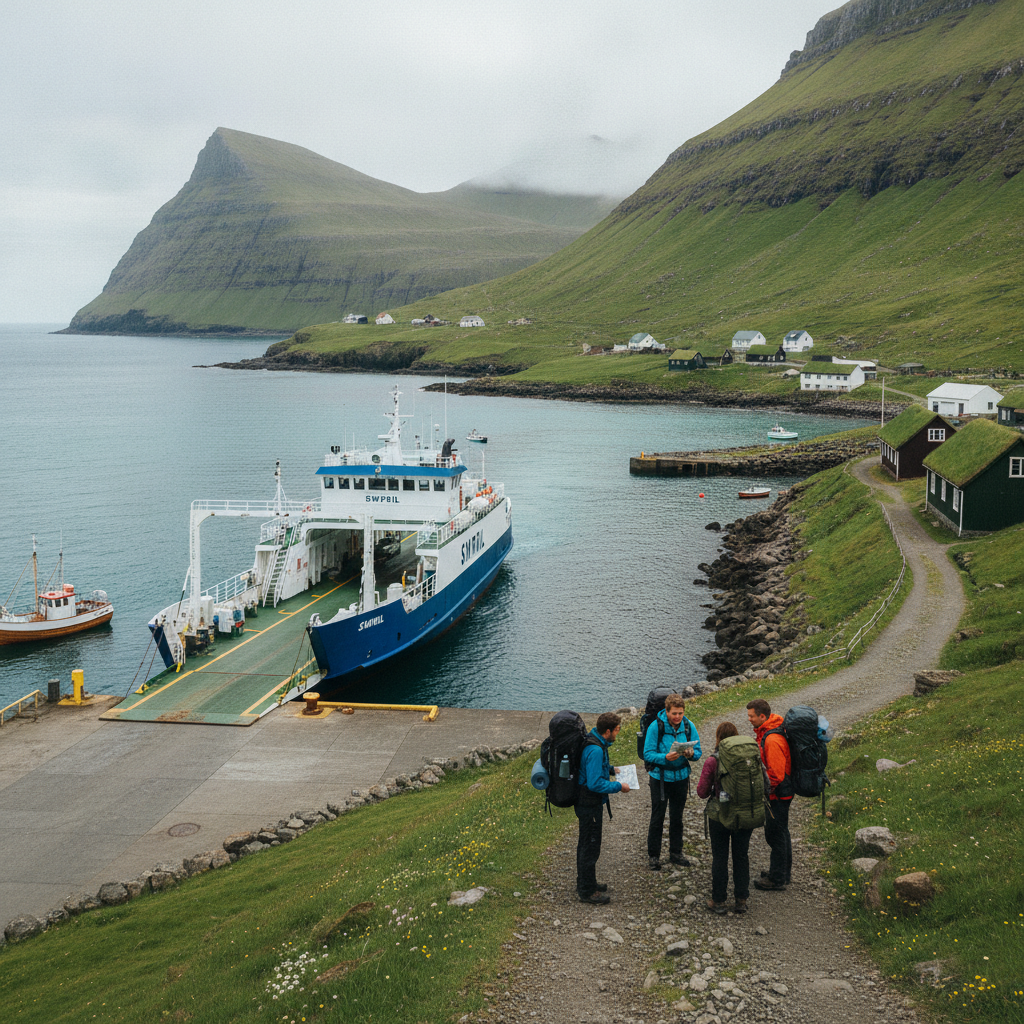
The Faroe Islands reward travelers who slow down and let the landscape unfold at its own pace. Eighteen islands of volcanic rock, grass-covered ridges, and salt-sprayed cliffs sit scattered in the North Atlantic, connected not by motorways but by tunnels, causeways, and a network of ferry routes that most visitors overlook entirely. For anyone willing to plan around the boats rather than a rental car, the ferries become more than transportation — they become the architecture of a genuinely memorable trip.
Start With the Strandfaraskip Landsins Schedule
The national ferry operator, Strandfaraskip Landsins, runs the interisland routes that make car-free travel possible across the archipelago. Before booking accommodation or planning any walking routes, download or print their timetable — it is the backbone of your entire itinerary. Routes connect islands like Suðuroy, Sandoy, and Skúvoy on predictable seasonal schedules, though frequency changes between summer and winter. Working backward from ferry departure times rather than forward from your wish list will save you from designing days that sound great on paper but don't actually connect.
Build Your Itinerary Around Torshavn as a Hub
Torshavn, the compact Faroese capital on Streymoy, is where most ferries originate or pass through, making it the natural anchor for a car-free itinerary. Rather than treating it as one stop among many, use it as your base for the first couple of days while you get your bearings, then return between island excursions when timing requires an overnight. The old town quarter of Tinganes is easy to explore on foot, and the city's size makes walking between the ferry terminal, guesthouses, and local restaurants completely effortless.
Use the Suðuroy Ferry as an Overnight Reset
The ferry crossing to Suðuroy, the southernmost island, takes roughly two hours each way from Tórshavn and runs multiple times daily on most days. Because Suðuroy sees fewer visitors than the northern islands, an overnight stay in the village of Tvøroyri gives you an almost private experience of Faroese daily life. Plan a full day of walking between villages along the island's well-marked trail network, then catch the return ferry the following morning. This approach turns what most people treat as a day trip into a genuinely immersive detour.
Pair the Sandoy Route With Village Walking Trails
Sandoy sits roughly forty minutes south of Tórshavn by ferry and offers one of the most accessible combinations of boat travel and on-foot exploration in the archipelago. The island's flat central interior and coastal cliffs are connected by clear village paths, and the main settlement of Sandur is small enough to explore without any additional transport. Time your ferry to arrive mid-morning, walk through to the beach at Søltuvík, and return to catch a late-afternoon departure. The rhythm of arrival by boat and exploration on foot is exactly what car-free travel in the Faroes is built for.
Factor in Undersea Tunnel Connections for Flexibility
The Faroe Islands have invested heavily in a network of subsea road tunnels connecting many of the northern islands, and public buses run through them on a fixed schedule. The Eysturoyartunnilin, which opened relatively recently, links Streymoy to Eysturoy and Borðoy beneath the seabed. For car-free travelers, these tunnels effectively expand the ferry network — a bus ride through the tunnel combined with a ferry leg can open up island combinations that seem impossible at first glance. Checking the Faroese public bus app alongside the ferry timetable reveals routing options that aren't obvious when you look at either system alone.
Carry a Buffer Day for Weather Disruptions
The North Atlantic does not operate on a tourist's schedule. Ferry crossings can be reduced or cancelled in heavy wind and swell, which are not unusual conditions for an archipelago at this latitude. Building at least one unscheduled buffer day into a week-long itinerary is not pessimism — it's practical planning. Use that day to revisit a village you rushed through, linger over a longer walk, or simply sit with the landscape. Travelers who fight the disruption almost always have a worse experience than those who accept it as part of how travel in this part of the world works.
Plan Accommodation in the Villages, Not Just the Capital
Staying in Tórshavn every night is convenient but misses much of what makes the islands distinct. Small guesthouses in villages like Nes on Eysturoy or Hvalba on Suðuroy put you within easy walking distance of trailheads and let you experience the quiet that settles over Faroese communities after dark. Booking these well in advance matters — rural accommodation is genuinely limited. The practical upside is that village guesthouses often include breakfast, which simplifies morning logistics considerably when you're timing arrivals at a nearby ferry terminal.
Let the Return Ferry Crossing Be Part of the Experience
Some ferry legs in the Faroes are as visually rewarding as the destinations themselves. The crossing between islands passes cliff faces that drop vertically into the ocean, bird colonies on narrow sea stacks, and light conditions that shift dramatically depending on the time of day and season. Choosing a window seat and treating the crossing as an active part of the trip — rather than dead time between points — changes the quality of the entire journey. Travelers who plan their itinerary this way tend to leave the archipelago feeling like they understood it, rather than just visited it.
The Faroe Islands have gradually become better known among independent travelers, and the ferry infrastructure continues to improve alongside growing interest in the archipelago. New tunnel projects are regularly discussed, and sustainable tourism initiatives are shaping how access to the more fragile islands is managed. For anyone building a self-guided trip now, the current system already offers more flexibility than most visitors realize — the key is simply taking the time to understand how the pieces fit together before you arrive.