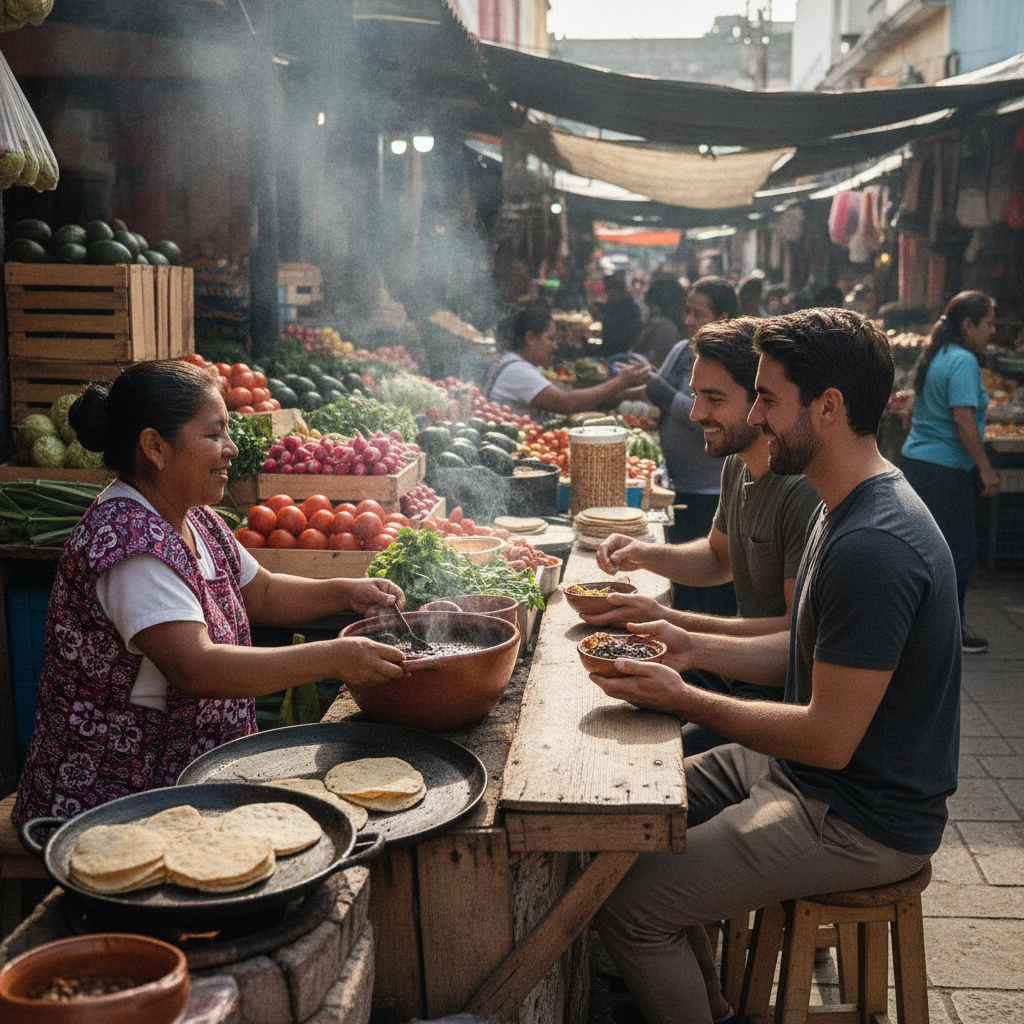
Food cooked in a restaurant kitchen and food prepared at a market stall can share the same ingredients, the same regional tradition, and even the same recipe — and still communicate entirely different things to the person eating it. In Oaxaca, this distinction carries particular weight. The city's mercados are not simply convenient places to find a cheap meal before moving on to something else. They are living archives of agricultural knowledge, social ritual, and culinary inheritance that restaurants, however skilled or celebrated, can only partially translate. To eat where Oaxacans eat — standing at a comal-side counter, breathing smoke from dried chiles being toasted directly over flame — is to receive information about a place that no menu description or travel article can quite replicate.
What the Mercado Transmits That Menus Cannot
The mercados of Oaxaca, particularly Mercado Benito Juárez and Mercado 20 de Noviembre in the city center, operate on a logic that is entirely different from the restaurant model. In a restaurant, even a traditional one, the kitchen is hidden, the ingredients are pre-selected, and the experience is curated for comfort. At a market stall, the production is inseparable from the consumption. A traveler sitting at the counter of a *comedor* — the informal food stalls that line the interior corridors of these markets — can watch corn masa being pressed into *tlayudas* by hand, observe the layering of *asiento* (unrefined pork fat), black beans, and *quesillo* (Oaxacan string cheese), and understand through observation alone how each component carries its own regional logic. The ingredients aren't explained; they simply appear, doing what they've always done.
This proximity matters in ways that are easy to underestimate. When a dish like *mole negro* arrives at a restaurant table, it carries enormous complexity — more than twenty ingredients, days of preparation, a depth of flavor that took generations to develop. But it arrives contained, already resolved. At a market stall, mole is prepared in full view, ladled from clay pots that have been simmering since early morning, and served in portions sized for working people eating between obligations. The context changes what the dish means. It stops being a culinary achievement to admire and becomes a communal daily practice to participate in.
The Social Architecture of Eating Together in Public
Oaxacan market culture carries within it an understanding of eating as a shared, social act rather than a private or transactional one. The counters at market comedores are long and linear, designed so that strangers sit beside each other. There is no pretense of private dining, no acoustic insulation between tables. Someone ordering *tasajo* — the thin-sliced, air-dried beef that is one of Oaxaca's most distinctive preparations — will likely be eating beside someone who orders nothing more elaborate than a bowl of *caldo de pollo* with fresh tortillas. The range of what's available and who is eating it tells a story about the community's relationship with its own food that no curated dining environment can replicate. Families stop in after the school run. Market vendors take their own breaks at neighboring stalls. Elderly women sit with plastic bags of ingredients they've just purchased. To eat among them is not to observe a community from outside but to briefly enter its ordinary rhythm.
Language, too, moves differently in this context. Even without shared vocabulary, the gestures of pointing, nodding, watching what someone else is eating and indicating you'd like the same — these are the actual mechanisms of cross-cultural exchange. The patience required to navigate a meal without a bilingual menu builds a different quality of attention than the ease of a translated restaurant experience. That attention, once cultivated, changes how a traveler moves through the rest of the day.
What Gets Lost in the Translation to Restaurant Dining
This is not an argument against Oaxaca's restaurants, several of which — including the celebrated Casa Oaxaca and the more neighborhood-rooted Itanoni — do extraordinary work preserving and interpreting regional ingredients. The point is more specific: a diet of restaurant meals creates a particular relationship with a place, one where the traveler is consistently positioned as a recipient of curated experience rather than a participant in lived culture. The difference is subtle at first but accumulates over days. A traveler who eats every meal in a restaurant returns home with memories organized around the quality of service, the presentation of dishes, the atmosphere of rooms. A traveler who spends several mornings at Mercado de Tlacolula — the sprawling Sunday market in the Valley of Oaxaca, one of the most significant in the region — returns with memories organized differently: the smell of *tejate*, the ancient chocolate-corn drink prepared cold in ceramic bowls, the speed at which vendors work, the sound of Zapotec being spoken around commercial exchanges that have continued in essentially this form for centuries.
That Sunday market at Tlacolula is particularly instructive. It draws communities from across the Central Valleys, and its food section functions as a real-time map of what is grown, raised, and prepared in the surrounding region. Vendors selling *chapulines* — toasted grasshoppers seasoned with lime and chile — are neighbors to vendors selling fresh *hierba santa*, the anise-scented herb used to wrap tamales or flavor mole amarillo. Seeing these ingredients in proximity, understanding them as part of the same regional ecosystem rather than exotic menu items, builds a kind of geographic literacy that no amount of research fully replicates.
How to Let the Market Teach You
If you're planning time in Oaxaca, consider giving your first and last meals of each day to the mercados rather than the restaurant strip. Arrive at Mercado Benito Juárez before nine in the morning, when the breakfast comedores are at their most active and the tortillas are being pressed fresh. Order without a strategy — point at what looks most familiar to the people around you. Eat slowly and notice not just the food but the social choreography of the space: who eats alone, who eats in groups, how long people stay, what they order for children versus elders. Let the meal last longer than hunger requires. What you're gathering during that extra time isn't more food — it's a more accurate picture of ordinary life in a place that deserves to be understood on its own terms, not on the terms most convenient for visitors. The Oaxaca you carry home from a table at Mercado 20 de Noviembre will be measurably more specific, more textured, and more true than the one assembled from restaurant dining rooms alone.
Food has always been one of the most direct routes into understanding how a community sustains itself — not just physically, but culturally and socially. The mercados of Oaxaca don't offer a simplified or tourist-facing version of that sustenance. They offer the real thing, in real time, alongside the people for whom it is simply Tuesday. That is the rarest and most valuable thing a traveler can find: not a place performing itself for an audience, but a place simply continuing to be itself.