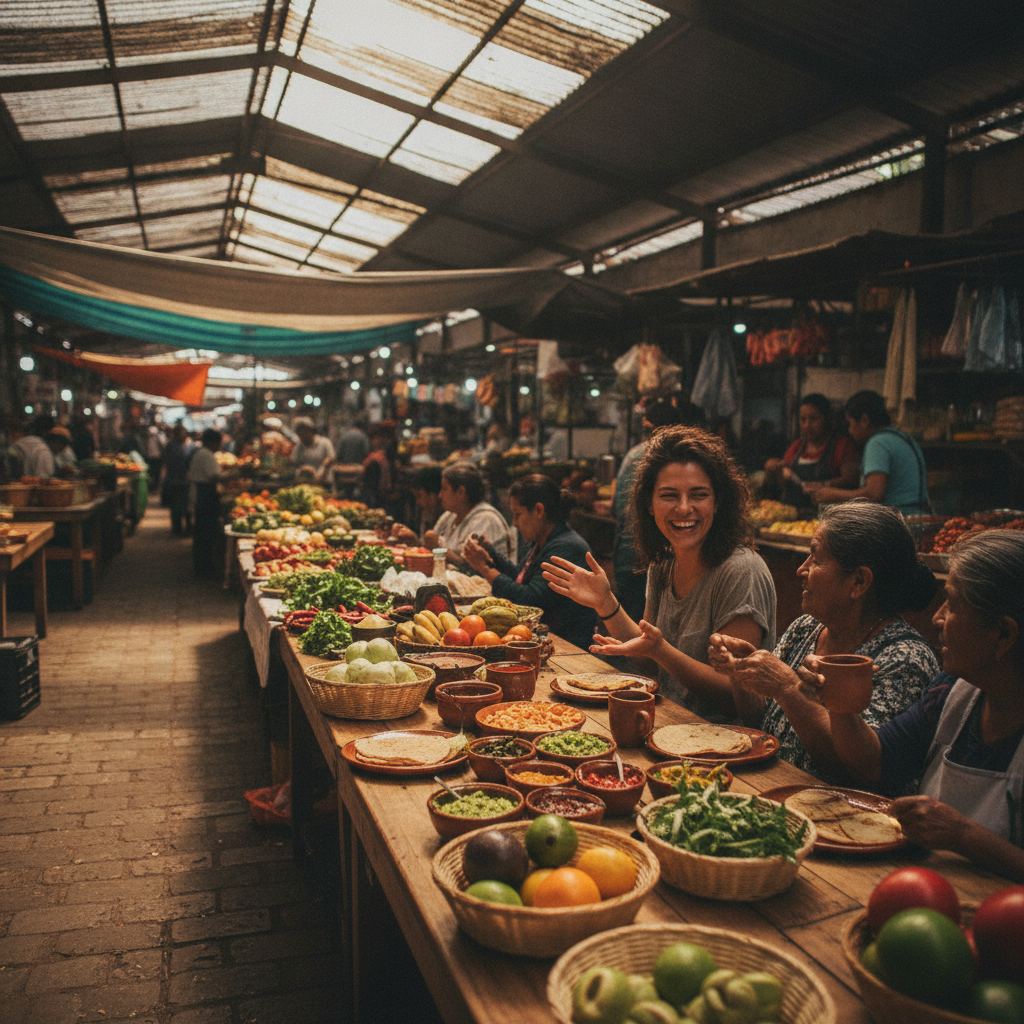
The soul of a city rarely lives in its restaurants. It lives in the stalls, the noise, the morning light cutting through corrugated roofing, and the vendor who has been slicing the same cured meat for thirty years. Covered municipal markets — those sprawling, permanent structures built in the nineteenth and early twentieth centuries to bring the food supply indoors — have survived supermarkets, tourism, and shifting demographics precisely because they remain genuinely necessary to the people who use them daily. When a traveler decides to eat nothing but market meals for the entirety of a trip, something shifts. The experience moves from observation to participation, from touring a culture to inhabiting one of its most essential rhythms.
The Architecture of Daily Life
The covered market is not incidental to urban culture — it is the mechanism through which a city feeds itself, negotiates prices, maintains social bonds, and transmits culinary memory from one generation to the next. In Valencia, Spain, the Mercado Central occupies a building of Modernista splendor, its iron vaults and mosaic tilework framing displays of salt-cured fish and locally grown oranges with an almost theatrical grandeur. In Tbilisi, the Dezerter Bazaar operates on a more informal logic — stalls crowded together, vendors calling across narrow aisles, the smell of churchkhela (walnut chains dipped in grape must, a traditional Georgian confection) mixing with dried herbs and fresh matsoni. In both cases, the market is less a place to shop than a place to *be*, and returning to it three times a day compresses weeks of cultural education into a single morning.
What Repetition Reveals
One visit to a market produces impressions. Multiple visits produce understanding. A traveler who eats breakfast, lunch, and dinner within the same set of covered stalls begins to notice things that a single pass would never surface: which vendors see their crowds thin by mid-afternoon, which items appear only on certain days, who speaks to whom and in what register of familiarity. The bocadillo de calamares at Madrid's Mercado de San Miguel is an obvious tourist draw, but the stall beside it — the one selling boquerones en vinagre to a steady stream of older locals who barely glance at the menu — tells a more nuanced story about what the neighborhood actually values. Repetition strips away the curated surface and allows the underlying logic of a food culture to become visible. Vendors begin to recognize a returning face; brief exchanges accumulate; the place becomes, in some small but genuine way, familiar.
Familiarity, in this context, is not a diminishment of wonder but a deepening of it. The traveler who has eaten at the same market counter four mornings in a row develops an intuitive sense of what ingredients are seasonal and local versus what feels imported and ceremonial. They understand — without being told — that the pile of fresh fava beans means spring, that the sudden abundance of dried peppers signals the shift into autumn. This kind of reading is not available in a restaurant, where the kitchen mediates everything. The market is raw and unfiltered, its logic dictated by what arrived that morning.
The Language of Ingredients
Covered municipal markets carry linguistic richness that guidebooks rarely capture. In Marrakech's covered sections near the medina, the distinction between ras el hanout (a complex spice blend whose precise composition varies by vendor) and simpler pre-mixed offerings signals debates about authenticity and regional tradition that have continued for generations. In Budapest's Nagycsarnok — the Great Market Hall — the vendors selling lángos (fried dough, a Hungarian street food staple) occupy a separate register from those selling paprika-heavy sausages, each stall embedded in its own social context. Listening to how vendors talk about their products, watching which items prompt spontaneous commentary and which are sold in businesslike silence, reveals a hierarchy of cultural pride that no cultural summary could adequately convey.
For the traveler committed to eating entirely within these walls, every meal becomes an act of reading. The decision of what to order is shaped not by a printed menu but by what looks freshest, what the person ahead ordered, what the vendor seemed most eager to recommend. These small negotiations with uncertainty are precisely the kind of engagement that produces lasting memory — not the photograph of a dish but the slightly awkward, entirely genuine interaction that preceded it.
A Different Kind of Value
Beyond the cultural and experiential dimension, eating exclusively at covered markets is a form of traveling that respects the local economy in a direct and meaningful way. Tourist-facing restaurants often operate at a remove from the supply chains that sustain a city's daily food culture. Market vendors, by contrast, are embedded in those chains — some growing or producing their own goods, others sourcing from regional suppliers whose livelihoods depend on the market remaining viable. The money spent at a market counter tends to stay closer to its origin, moving through fewer intermediary layers before reaching those who grew, raised, or prepared the food. This is not an abstract ethical position; it's a practical consequence of how municipal markets are structured, and it makes each meal feel less like a consumption choice and more like a small act of participation.
Finding Your Rhythm in the Stalls
If you're planning a trip around market eating, the approach matters as much as the intention. Arrive before nine in the morning at least once — the atmosphere is entirely different from midday, the vendors more relaxed, the produce arrangements at their most careful. Learn two or three words in the local language: the word for *how much*, the word for *please*, the word for *this one*. Bring a small bag. Carry cash. Accept that the first morning will feel disorienting and the third will feel like routine, and understand that the distance between those two feelings is where the real travel happens. The Boqueria in Barcelona is crowded and visually spectacular, but the smaller covered markets in the Gràcia neighborhood or the Eixample offer more genuine daily-life encounters for those willing to walk fifteen extra minutes.
There is a particular quality of attention that sustained market eating produces — a calibration of the senses toward what is local, seasonal, and human-scaled. A traveler who returns home having eaten nothing but market meals for ten days carries something different than one who collected restaurant receipts. They carry a working knowledge of a place's pantry, its rhythms, its social codes, its small pleasures. The soul of a city, after all, rarely lives in its restaurants — and those who eat where it actually does come home knowing something real.