The human body knows the difference between a room that was designed to hold it and one that simply contains it. This distinction, subtle as it sounds, shapes how deeply a person can rest, how quickly the nervous system settles, and whether a space ever truly becomes a refuge or remains just another room with furniture in it. Across cultures and centuries, the idea of a deliberately curated resting space has surfaced again and again — not as a luxury, but as a quiet form of self-knowledge.
The Sensory Environment Shapes Rest From the Start
Before the body sleeps, the senses are already at work processing the room. Light levels, ambient sound, temperature, scent, and even the visual complexity of a space all send signals to the nervous system — signals that either ease it toward stillness or keep it quietly alert. When a room contains too many competing stimuli, the brain continues scanning even as the body tries to rest. Designers and sleep researchers have long understood that reducing sensory noise isn't about creating emptiness; it's about creating coherence, a room that speaks in one calm register rather than many competing ones.
What "Deliberate Sensory Calm" Actually Means
The phrase borrows loosely from the Japanese concept of *kanso* — a design principle rooted in Zen aesthetics that emphasizes simplicity and the elimination of clutter, not for visual minimalism's sake, but to reduce the mental effort of processing a space. A room built around deliberate sensory calm doesn't need to be sparse or cold. It simply prioritizes consistency: a narrow color palette, controlled light sources, minimal visual interruption, and materials chosen for how they feel as much as how they look. Brands like Muji and Hay have built entire product lines around this idea, offering objects that recede rather than demand attention, contributing to a room's atmosphere without fracturing it.
The Role of Light in Training the Body to Wind Down
Of all sensory inputs, light carries the most direct line to the body's internal clock. Cool, bright overhead lighting signals alertness; warm, low-level light in the amber spectrum encourages melatonin production and signals the approach of rest. A room designed around sensory calm typically removes overhead fixtures from the evening equation entirely, replacing them with bedside lamps, wall sconces, or floor lamps positioned below eye level. Neighborhoods like Nørrebro in Copenhagen, known for their thoughtful domestic interiors, have popularized the Danish concept of *hygge* — the cultivation of coziness through layered, low lighting — precisely because it works. Light is architecture the body can feel.
Sound, Texture, and the Quieter Senses
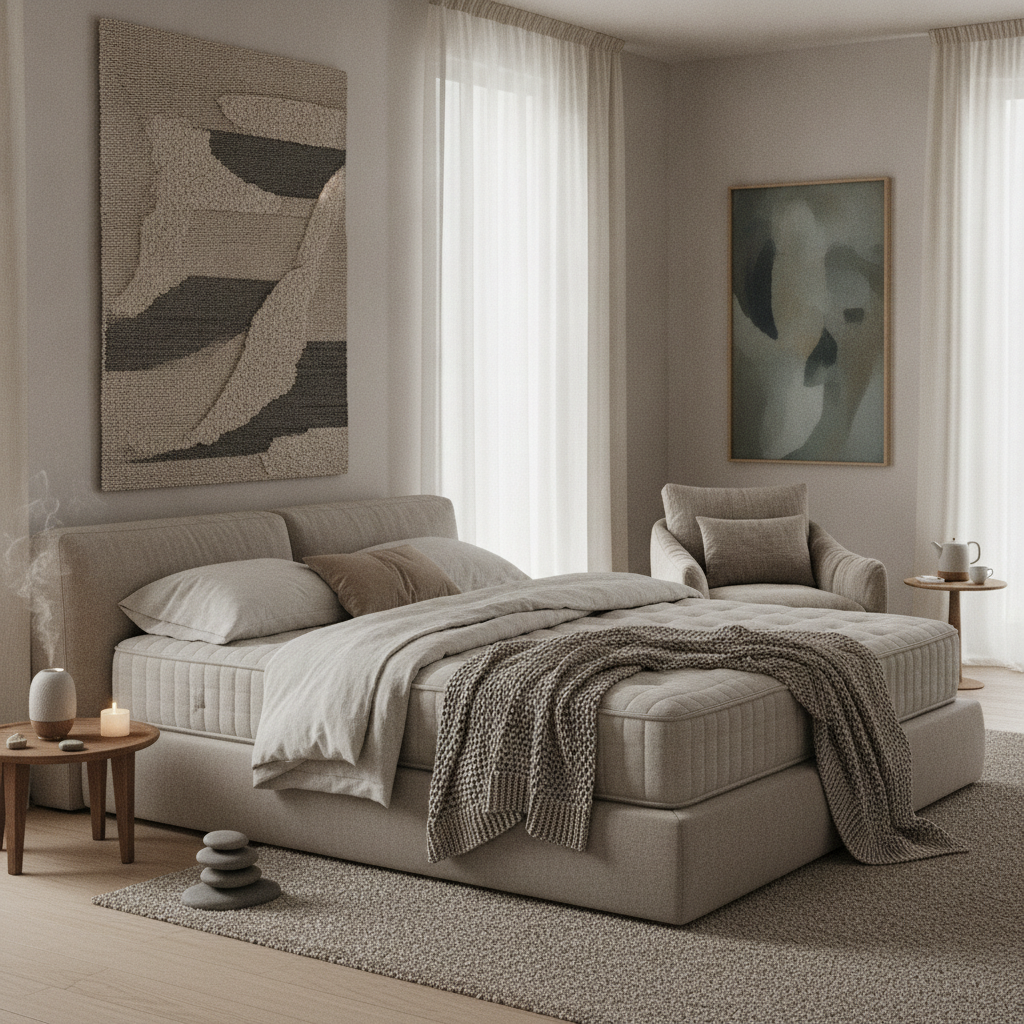
Sound is often the last thing people think to address and the first thing that fractures rest. Hard surfaces reflect noise; soft ones absorb it. A room fitted with heavy curtains, a substantial rug, upholstered furniture, and natural fiber bedding doesn't just look restful — it sounds it. The acoustic texture of a space affects mood in ways that don't announce themselves consciously but register steadily. Scent works similarly. A single consistent fragrance — lavender, cedarwood, or sandalwood used through a diffuser or candles from makers like Aesop or Skandinavisk — becomes associated through repetition with rest itself, training the brain to recognize the room as a place where the work of the day ends.
Why One Room Matters More Than a Whole-Home Overhaul
The temptation when embracing slower, more intentional home design is to address everything at once. This tends to produce fatigue rather than calm. There's considerable practical wisdom in choosing one room — almost always the bedroom, sometimes a reading room or a small sitting space — and committing to it fully before anything else. When a single room is made genuinely restful, its effect on the people who use it is disproportionately large. The body begins to associate that room with restoration, and the association deepens over time. Sleep researchers refer to this as *stimulus control* — the process by which environmental cues reliably trigger particular mental states. A well-designed room becomes its own quiet instruction.
Removing What Competes With Rest
Designing for sensory calm is as much a process of subtraction as addition. Screens are the most obvious candidate for removal, not because technology is inherently harmful but because their light spectrum and the behavioral patterns they invite — scrolling, reacting, comparing — are precisely the opposite of what a resting room requires. Beyond screens, visual clutter, exercise equipment, work materials, and even bold artwork can keep the room in a different register than rest. The principle at work here echoes the Indian concept of *vastu shastra*, an ancient spatial philosophy concerned with how the arrangement and energy of a room affects the well-being of those who inhabit it. Different tradition, same core insight: what shares a room with you shapes how you feel in it.
Creating This Space as a Gradual, Considered Practice
If you're drawn to the idea of building one room around deliberate calm, the most effective approach is slow and cumulative. Begin with light — swap one overhead fixture for a warmer, lower option and observe the difference over a week. Then address sound, adding a rug or heavier curtains if the room echoes. Choose a single scent and use it only in this space. Remove one object that introduces visual noise rather than visual peace. Over several weeks, the room begins to shift — not through any single dramatic change but through the accumulation of small, intentional ones. The body notices before the mind fully registers it, settling a little faster each time the door closes.
There is something quietly profound in the idea that the quality of a person's rest can be shaped by the deliberate design of the room that holds it — that rest is not purely biological but partly environmental, partly a conversation between a body and the space it trusts. The human need for refuge isn't new, and neither is the instinct to shape that refuge with care. A room built around sensory calm doesn't announce itself. It simply does its work, night after night, in the patient language of light and texture and stillness.