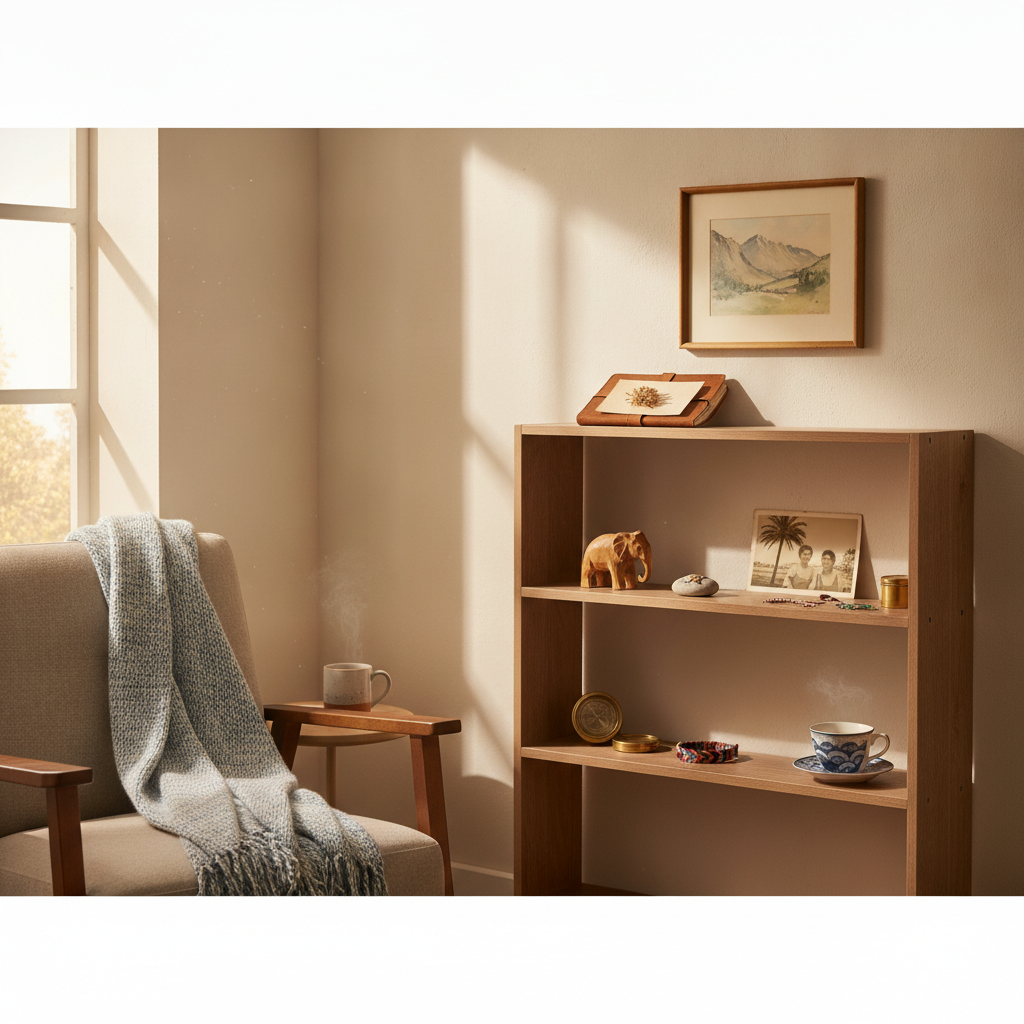
A room can hold many things and still feel empty in the ways that matter most. Most interiors are organized around function — where the lamp goes, what fits beside the window, which surface is available for whatever lands on it at the end of a long day. Objects accumulate not because they are chosen but because they persist, and slowly the room becomes a record of inertia rather than intention. Something shifts, though, when one surface in that space is set aside deliberately, reserved only for the things that carry genuine personal weight.
The Quiet Power of Designated Space
There is a concept in Japanese aesthetics called *tokonoma* — a recessed alcove traditionally found in a tatami room, intended to display a single scroll, a ceramic vessel, or a seasonal arrangement of flowers. The tokonoma is never cluttered. Its purpose is not storage but contemplation, and its emptiness around the central object is considered as important as the object itself. This principle, though centuries old, speaks directly to something many people sense but rarely articulate: that a dedicated space for meaning changes the emotional register of an entire room, not just the corner it occupies.
Why Objects Need Context to Be Felt
An object placed on any available surface becomes furniture in the broadest sense — background. The same object placed on a shelf reserved for things that matter becomes something closer to a presence. Neurologically, the human eye is drawn to contrast and curation, and when a surface is visually calm and intentional, the objects resting on it receive a quality of attention they would never earn otherwise. A smooth stone carried home from the Cinque Terre coastline, a small brass figurine bought at a market in Tbilisi, a folded letter kept for a decade — these things carry private histories, but those histories remain dormant when the objects are buried among chargers, candles, and mail. Context allows meaning to surface.
How the Shelf Reshapes Daily Perception
Living with a dedicated shelf is less about decoration than about rhythm. Each morning and evening, the eye passes over it, and in that brief passage, something is recalled — a person, a place, a moment when something became clear. This is not a dramatic experience. It is quiet and almost involuntary, the way a particular song recalls a year without any effort on the part of the listener. Interior designers working in cities like Copenhagen and Kyoto have long understood that rooms which include one intentionally underfurnished surface create a measurable sense of breathing room, a quality that full rooms with beautiful objects still lack when nothing has been given primacy.
Selecting What Belongs and What Does Not
The discipline of the shelf lies in its restriction. Not everything meaningful qualifies. The selection process itself becomes a form of self-knowledge — a quiet reckoning with what actually matters versus what merely feels familiar. *Wabi-sabi*, the Japanese philosophy of finding beauty in imperfection and impermanence, offers useful guidance here: the objects that belong on a meaningful shelf are rarely pristine or expensive. They are often worn, small, and specific to a private story no one else fully shares. A chipped mug from a grandmother's kitchen, a ticket stub from a first solo trip, a child's drawing kept past all reason — these qualify not because they are beautiful but because they are irreplaceable in the exact way they are.
The Effect on Other People Who Enter the Space
Something interesting happens when guests encounter a thoughtfully kept shelf. They slow down. They ask questions. The shelf becomes a point of conversation that generic décor almost never generates, because it signals that a person lives there — not just a household. This social dimension of the meaningful shelf is underappreciated. In the same way that a well-chosen bookshelf in a room invites people to understand something true about a host, a shelf of personal objects offers a kind of introduction that no amount of expensive furniture can replicate. The room begins to feel inhabited in a way that interior styling alone cannot manufacture.
Maintaining the Shelf Without Letting It Drift
The greatest threat to a dedicated meaningful shelf is the same force that fills every other surface: convenience. A shelf at a useful height will attract keys, receipts, and whatever is in hand when someone walks through the door. Protecting it requires a small, consistent practice — returning displaced objects, resisting the impulse to set things down temporarily. Some people find it useful to treat the shelf as they might treat a small altar, a term used across many traditions, from Hindu *puja* spaces to Mexican *ofrendas*, to describe a surface maintained with intention rather than utility. The word need not carry religious weight to be useful; it simply names the practice of keeping one space free from the ordinary drift of household life.
Living Differently Within the Same Four Walls
You don't need a new apartment, a renovation, or a different city to change how a room feels to live in. You need one surface, kept with care, holding the things that remind you who you are when the noise of the week has made that harder to remember. Choose the shelf with some thought — not the busiest wall, not the most trafficked corner, but somewhere your gaze naturally rests during the quieter parts of the day. Put on it only what genuinely moves something in you, and resist filling the gaps. Let the space between objects breathe. Then notice, over the weeks that follow, whether the room begins to feel less like a place you inhabit and more like a place that knows you.
There is something both simple and profound in the idea that a room's atmosphere can shift because of a single shelf treated with intention. The same walls, the same furniture, the same light — and yet a different quality of presence. It returns, in the end, to that first observation: a room can hold many things and still feel empty. What the dedicated shelf offers is not more, but truer — a small act of curation that gradually changes what it feels like to come home.