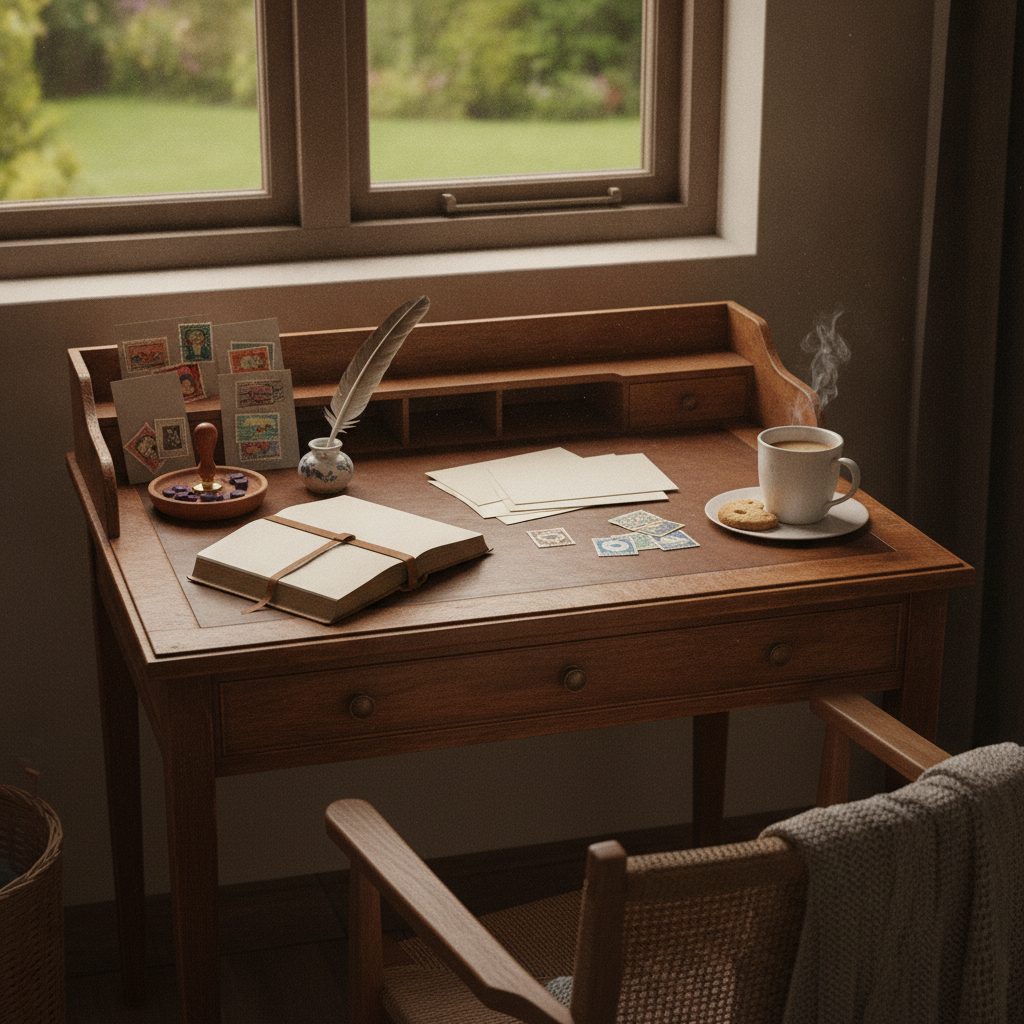
There is a particular kind of silence that settles over a relationship when both people mean to write but never quite do. The intention is genuine — the affection is real — but without a surface to write on, an envelope within reach, or a stamp already waiting in a small ceramic dish, the moment passes. Days become weeks. The letter never gets written. What separates people who maintain rich, ongoing correspondence from those who don't is rarely a matter of feeling; it's almost always a matter of arrangement.
The Friction That Keeps Letters Unwritten
The behavioral concept of *activation energy* — borrowed from chemistry and loosely applied to habit design — describes the effort required to begin any action. When the threshold is high, even motivated people hesitate. When it's low, almost anyone follows through. Writing a letter to someone you genuinely miss takes very little emotional energy; finding a pen that works, locating paper, tracking down an envelope, hunting for stamps, and remembering the address takes considerably more. That accumulated friction is precisely why most people send a quick message instead and feel vaguely dissatisfied by the exchange afterward. A dedicated correspondence corner eliminates the friction before it has a chance to win.
The physical arrangement matters more than it might seem. A small writing desk tucked into the corner of a bedroom, a tray on a bookshelf in a study, or even a beautifully organized box kept on a side table — any of these can serve as what the Japanese call *ma* (間), a meaningful interval or space carved deliberately from the surrounding environment. The concept in its original architectural sense refers to the conscious use of emptiness; in the context of a correspondence corner, it means a space defined not by what fills it, but by the specific kind of attention it invites. When the stationery is already there, the corner becomes an ongoing quiet invitation rather than a project to be assembled.
What Belongs in the Corner
The most effective correspondence corners are assembled with restraint rather than abundance. A small supply of quality writing paper — brands like G. Lalo or Crane & Co. offer genuine quality without requiring a large investment — alongside a box of envelopes in a size that suits the paper, a reliable pen, a book of stamps, and a simple address book or a printed contact card is genuinely sufficient. Some people add a stick of sealing wax or a personal stamp seal, which adds a tactile ritual that makes the act of finishing a letter feel complete rather than administrative. A small tray or wooden organizer keeps everything visible and accessible, which matters more than aesthetics. When the supplies are tucked inside a drawer, they are functionally invisible.
The paper itself carries more psychological weight than most people expect. Writing on plain printer paper communicates something different from writing on a cotton-fiber sheet with a deckled edge. The choice of stationery signals to both writer and recipient that the correspondence belongs to a different register than a text message — that it was composed with some deliberateness, set apart from the stream of digital noise. That distinction is not sentimental; it has measurable effects on how carefully a letter is written and how long it is kept by the person who receives it.
The Ritual of Sitting Down to Write
Once the corner exists, something subtle shifts in the relationship between intention and action. The decision to write no longer requires assembling the conditions for writing — those conditions already exist. A person passes the corner on a quiet Saturday morning, notices the stack of cream envelopes, thinks of a friend who moved to Porto two years ago, and sits down. The letter gets written not because there was a plan to write it, but because the environment made the path of least resistance point directly toward the act. This is the mechanism behind every well-designed habit space: the behavior becomes the default.
There is also the matter of what writing by hand does to thought itself. The slower pace of a pen moving across paper creates a different kind of reflection than typing. Sentences arrive more considered. Details that would be filtered out of a quick message — a description of the light in the afternoon, a memory that surfaced while reading, a question asked out of genuine curiosity rather than politeness — find their way onto the page. Recipients notice. The letters they write back tend to be longer and more considered in return, which creates a correspondence that deepens over time rather than stalling at the level of brief check-ins.
Rebuilding Connection Across Distance
For people with friends and family spread across cities or continents — a reality that defines much of modern life — the correspondence corner becomes a quiet counterweight to the feeling that distance erodes relationships. There is a French term, *dépaysement*, that describes the disorientation of being removed from one's home environment. The inverse — the feeling of being remembered by someone far away, of holding a letter written in a familiar hand — has no single word in English, but it is profound and not easily replicated by digital means. A well-stocked correspondence corner makes it possible to produce that feeling for someone else on a regular basis, not as a grand gesture, but as a recurring small act that accumulates into something substantial.
The key, as with most sustainable habits, is to keep the practice proportionate. A single letter written each week, or even once a fortnight, to one of several people on a loose mental rotation, is far more connective than a burst of ambitious correspondence followed by months of silence. The corner makes the practice sustainable precisely because it removes the planning stage. The stationery is there. The stamps are there. All that remains is the sitting down.
Making the Corner Your Own
If you have spent years meaning to write more letters but rarely managing it, consider starting not with a resolution but with an arrangement. Choose a surface — even a small one — in a room you pass through daily. Stock it with paper you find genuinely pleasant to touch, a pen that feels good in the hand, and a book of stamps ordered from a postal service like Royal Mail or USPS with a design you find worth looking at. Write the first address in the address book before the corner is even fully assembled. The point is not perfection but proximity: the closer the tools are to the moment of impulse, the more often impulse becomes action.
The same silence that settles over relationships when letters go unwritten can, with one small rearrangement of a corner of a room, begin to lift. What changes is not the desire to stay in touch — that was always present — but the distance between the desire and the act. A correspondence corner does not manufacture affection. It simply stops getting in the way of expressing it.